Most dental Facebook ads look the same: a stock smile, “Book a free consultation,” and a button. People scroll right past them. The ads that book patients are more specific. They lead with one clear offer or answer, show a real local practice, and send people to one simple next step.
Below are 15 dental Facebook ad examples we wrote and designed, grouped by the four campaigns we put first: Invisalign, dental implants, emergencies, and first visits, plus four more ideas at the end. Each one comes with copy you can adapt, the format and audience to use, why it works, and the rule to check before it goes live. They are concept ads for a placeholder practice, so swap in your own photos, fees, and details. If you would rather have a team build and run them, that is what our Facebook ads for dentists service does.
Quick answer: The best dental Facebook ads lead with one specific offer or answer, use a 4:5 image or a vertical video of your real practice, keep the primary text between 50 and 150 characters, and send people to a page built to book. They describe the service instead of asking about the reader’s health or appearance, which keeps them inside Meta’s ad policies.
What the best dental ads have in common
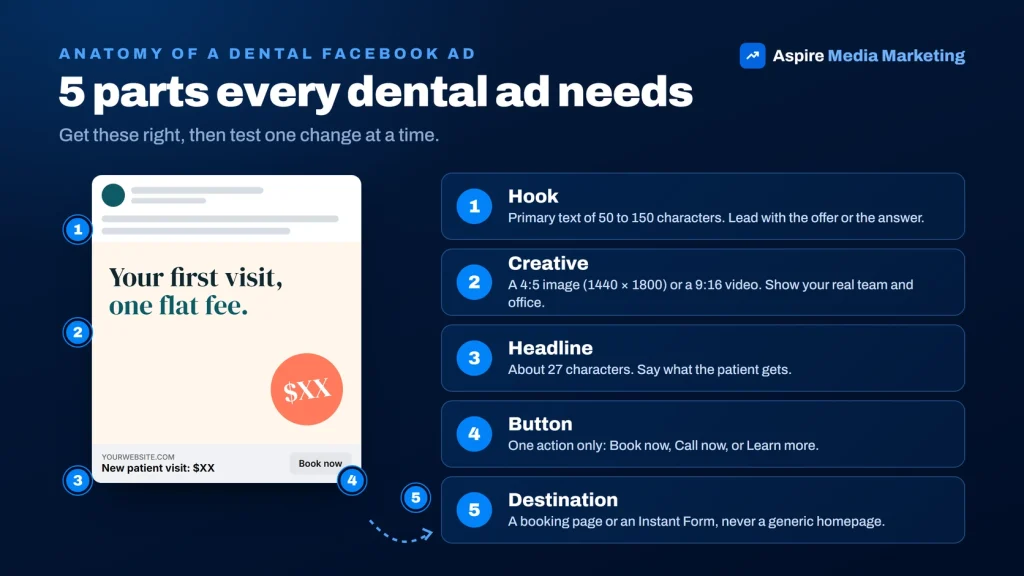
Every example below follows the same five-part structure. Get these right first, then test one change at a time.
- A hook in the first line. Facebook hides long primary text behind “See more,” so the offer or answer has to land first. Meta’s ads guide recommends 50 to 150 characters of primary text for feed image ads.
- A creative that stops the scroll. Meta recommends a 4:5 image at 1440 × 1800 pixels for the Facebook feed and a 9:16 format for Instagram Stories. Real photos and video of your own team and office show patients who they will actually meet, which stock photos cannot do.
- A short headline. Meta recommends about 27 characters. Say what the patient gets.
- One button. Book now, Call now, or Learn more. One ad, one action.
- A destination built to book. Send clicks to a page that repeats the offer and has a booking form, or to an Instant Form inside Facebook. A generic homepage makes people hunt for the offer they clicked on.
The fifth part is where many dental ads lose the patient, which is why every Meta ads campaign we run sends traffic to a dedicated page built to book, not the homepage.
Invisalign ad examples for Facebook and Instagram
Invisalign is where we would start. Clear aligners are one of dentistry’s highest-margin services, and the decision is visual, which makes these the most natural Instagram ads for dentists. Meta’s Health and Wellness policy requires ads for cosmetic procedures to be targeted to people 18 or older, so build them for adults and reach teens through their parents (example 4). Run these Invisalign ads as a set: the cost and FAQ ads warm people up, and the consultation ad turns them into bookings.
1. Invisalign consultation offer
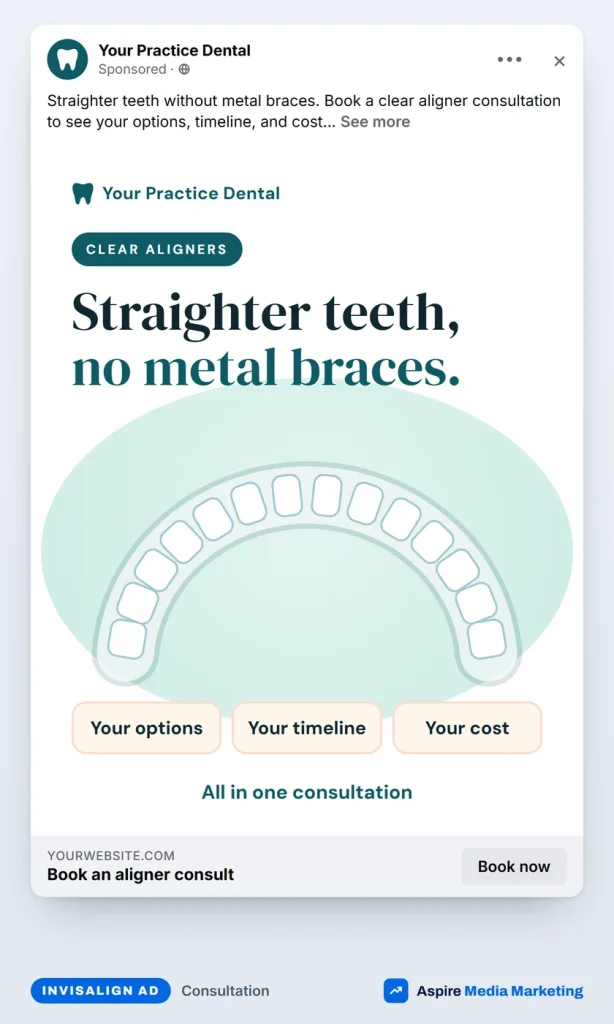
Primary text: Straighter teeth without metal braces. Book a clear aligner consultation to see your options, timeline, and cost before you decide.
Headline: Book an aligner consult
Button: Book now
Format: Single image for feeds, plus a 9:16 version for Instagram Stories. Audience: Adults 18 and older within a short drive.
Why it works: The two biggest questions about clear aligners are how long treatment takes and what it costs. The ad promises answers to both in one low-pressure consultation. For the wider strategy, see our Invisalign marketing strategies.
Before you run it: Treat aligner ads like cosmetic ads and target adults 18 and older; example 4 shows how to reach teens through their parents. Don’t ask “Embarrassed by your crooked teeth?”, because Meta bars cosmetic ads that attack a person’s appearance. If you want help running aligner campaigns, see our Invisalign marketing service.
2. Invisalign cost guide
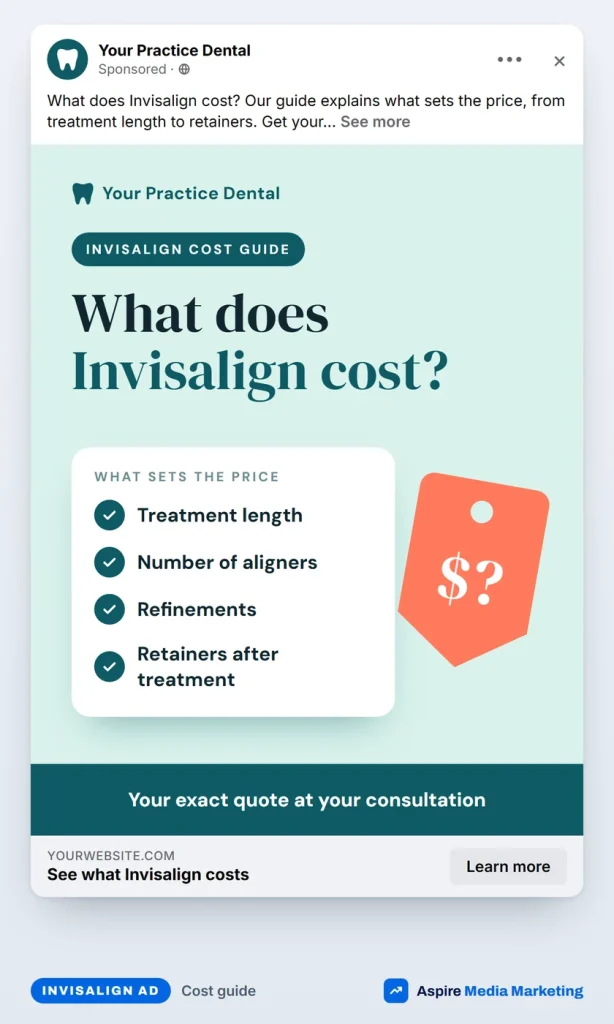
Primary text: What does Invisalign cost? Our guide explains what sets the price, from treatment length to retainers. Get your exact quote at a consult.
Headline: See what Invisalign costs
Button: Learn more
Format: Single image that links to your Invisalign cost page. Audience: Adults 18 and older within a short drive, plus people who engaged with your other aligner ads.
Why it works: Cost is often the question people want answered before they will book anything. Explaining what sets the price earns the click, and everyone who reads the cost page becomes a warm audience for the consultation ad.
Before you run it: In Ontario, any fee you state must be the maximum fee, including lab costs, and apply to every patient, so be careful with “starting at” prices there. Use the Invisalign name only if you are an Invisalign provider.
3. Invisalign FAQ carousel
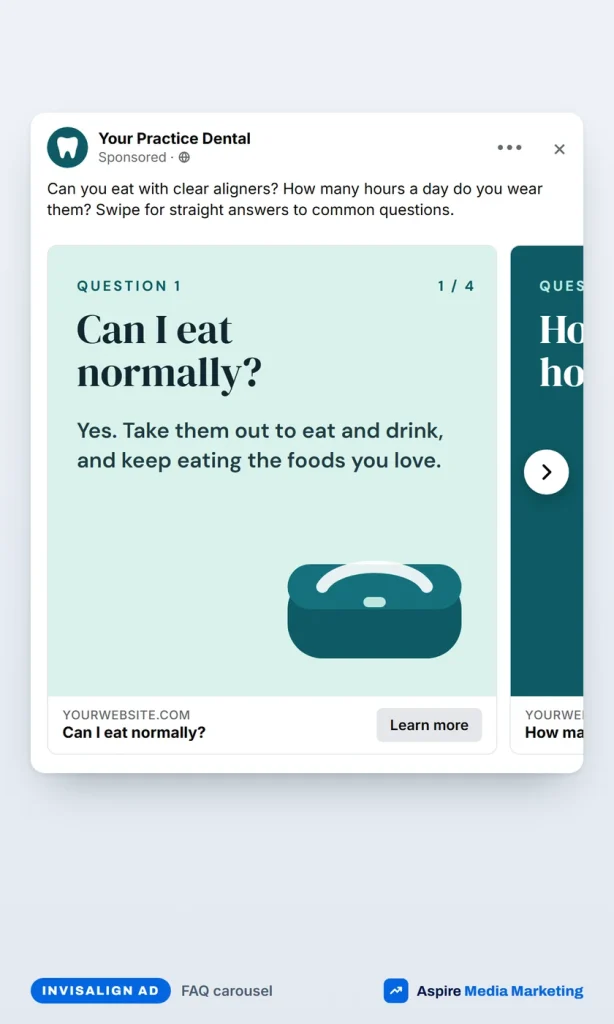
Primary text: Can you eat with clear aligners? How many hours a day do you wear them? Swipe for straight answers to common questions.
Headline: Your aligner questions
Button: Learn more
Format: Carousel, one question per 1:1 card. Audience: Adults 18 and older within a short drive.
Why it works: Everyday questions, like eating and daily wear, can hold people back as much as price. A carousel answers one question per card, and everyone who swipes becomes a warm audience for the consultation ad.
Before you run it: Keep the answers accurate. Invisalign’s own FAQ says people typically wear their aligners 20 to 22 hours a day and take them out to eat, drink, brush, and floss, so don’t suggest they can be left out for long.
4. Invisalign for teens, aimed at parents
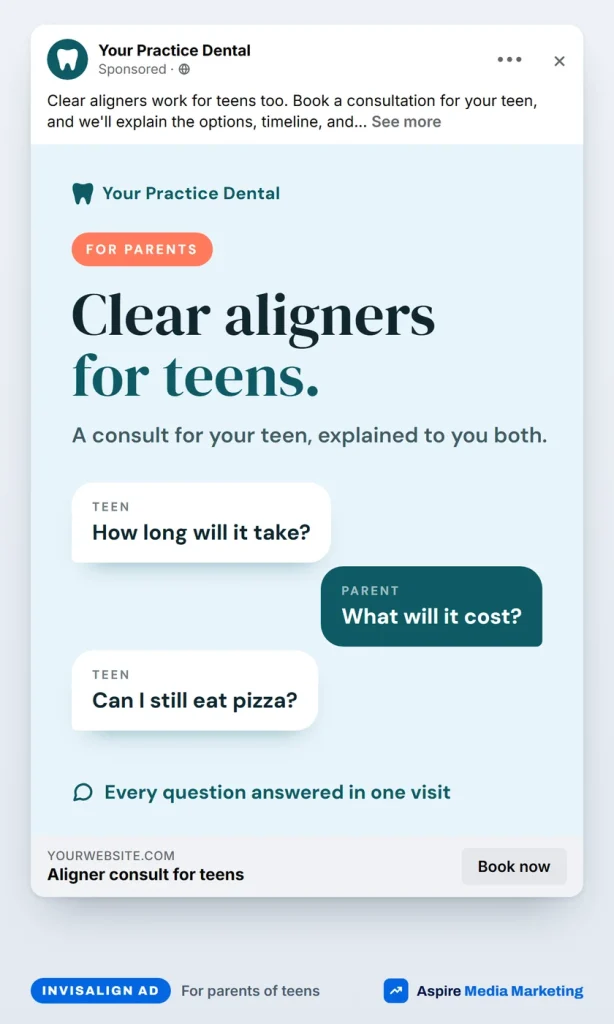
Primary text: Clear aligners work for teens too. Book a consultation for your teen, and we’ll explain the options, timeline, and cost to you both.
Headline: Aligner consult for teens
Button: Book now
Format: Single image, Facebook and Instagram feeds. Audience: Adults 30 to 55 within a short drive, because parents make the booking.
Why it works: Meta requires cosmetic procedure ads to target adults, and parents are the ones who book and pay anyway. Speaking to the parent keeps the ad compliant and puts it in front of the decision maker.
Before you run it: Target adults only. If you show a teen in the creative, get a parent’s written consent, and leave out before-and-after photos of minors.
Dental implant ad examples
Implant patients research for a long time before they book, so implant ads work best as a sequence: teach first, compare the options next, then answer the cost question and retarget the people who engaged. For the full plan, see our guide to dental implant marketing strategies.
5. Dental implant explainer carousel
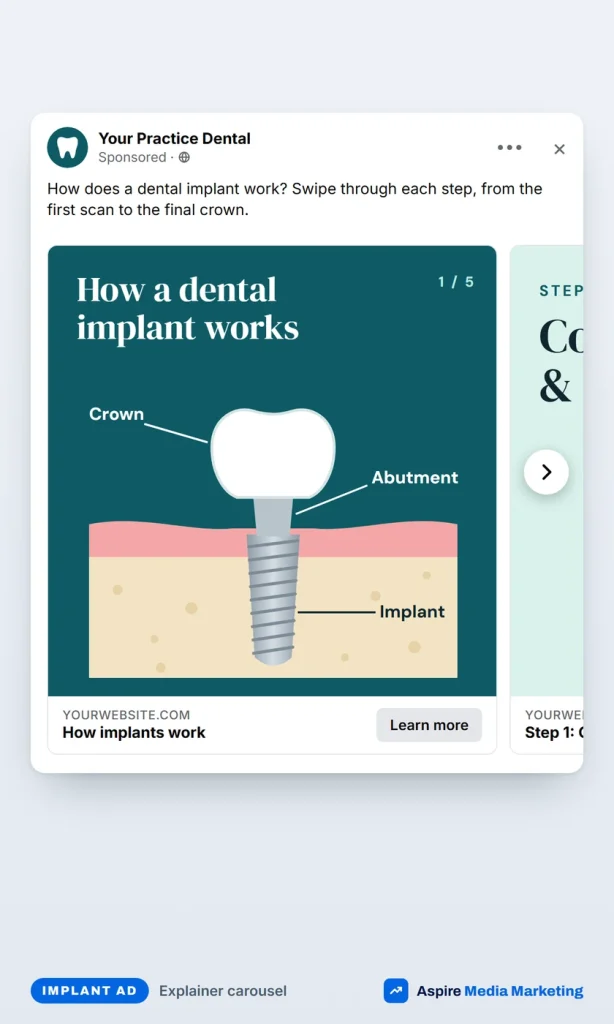
Primary text: How does a dental implant work? Swipe through each step, from the first scan to the final crown.
Headline: How implants work
Button: Learn more
Format: Carousel, one 1:1 card per step. Audience: Adults 35 and older within a wider radius than your checkup ads.
Why it works: Implants are a big decision, so teaching first earns trust before you ask for a consultation. A carousel fits a step-by-step story, and everyone who swipes becomes an audience for the next ad. For campaigns built around high-value cases, see our dental implant marketing.
Before you run it: Keep the explanation general and accurate, and don’t promise outcomes like “a permanent new tooth in one day.” In Ontario, a general dentist should not be described as an “implant specialist.”
6. Tooth replacement options consult
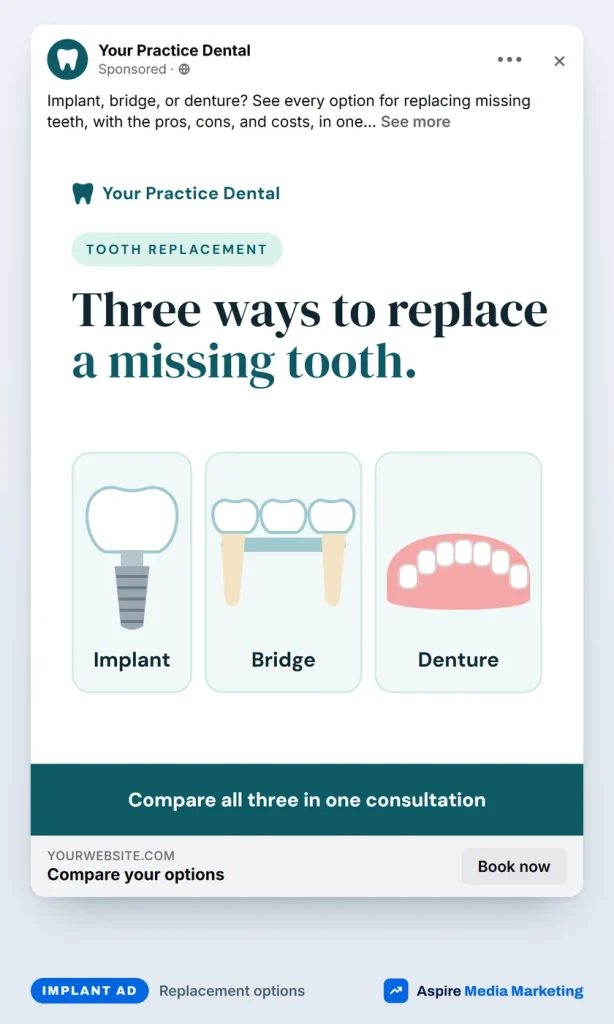
Primary text: Implant, bridge, or denture? See every option for replacing missing teeth, with the pros, cons, and costs, in one consultation.
Headline: Compare your options
Button: Book now
Format: Single image, or a short video of the dentist explaining each option. Audience: Adults 35 and older within a wider radius than your checkup ads.
Why it works: People researching implants are often weighing them against less expensive options. Showing all three makes the practice look honest, and the consultation becomes the place to decide.
Before you run it: Don’t open with “Missing a tooth?”, which asks about a health condition. Present each option fairly instead of claiming one is right for everyone.
7. Implant cost guide
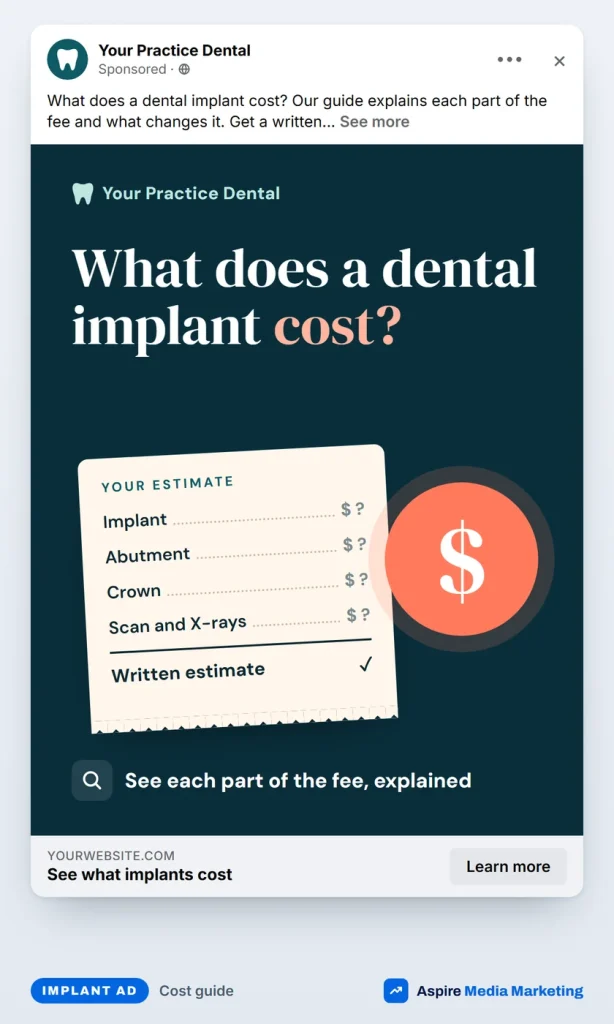
Primary text: What does a dental implant cost? Our guide explains each part of the fee and what changes it. Get a written estimate at your consult.
Headline: See what implants cost
Button: Learn more
Format: Single image that links to your implant cost page. Audience: Adults 35 and older, plus people who swiped the implant carousel.
Why it works: Cost is the first question many implant patients ask, so a guide that answers it earns the click. The page it links to does the explaining, and a written estimate gives the reader a concrete next step.
Before you run it: If you state a fee in Ontario, it must be the maximum fee, including lab costs, and apply to every patient. Mention financing only if you actually offer it.
Emergency dental ad examples
Emergency patients need you today, so these ads are about speed and recall. One gets the call now, and one makes sure your number is the one people have saved before anything happens. Both describe the situation without asking about the reader’s health.
8. Same-day emergency appointments
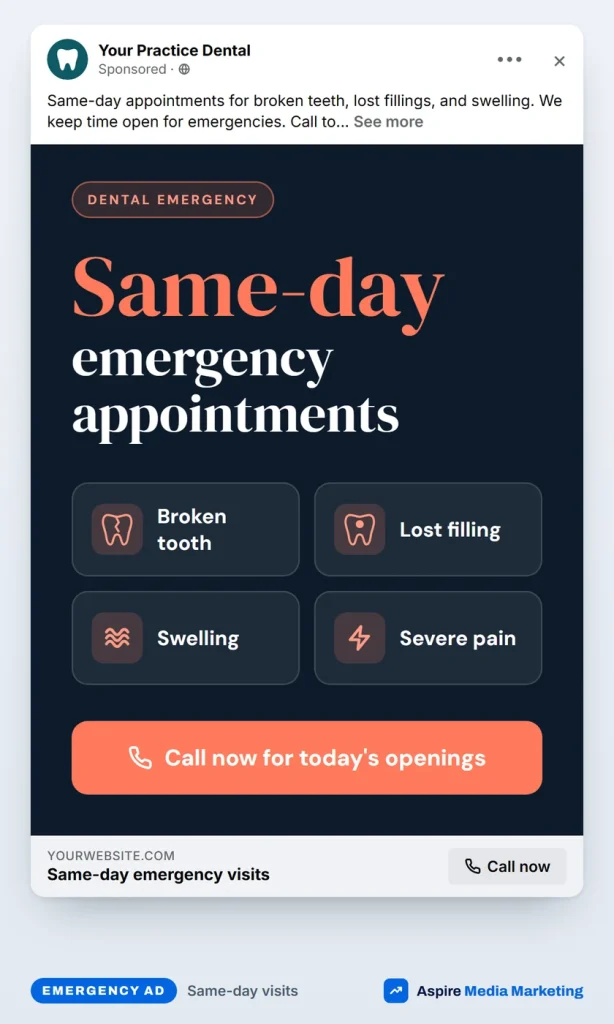
Primary text: Same-day appointments for broken teeth, lost fillings, and swelling. We keep time open for emergencies. Call to check today’s openings.
Headline: Same-day emergency visits
Button: Call now
Format: Single image with a Call now button. Audience: Everyone within a short drive, running all day.
Why it works: An urgent need plus a Call now button is the shortest path from ad to appointment. Listing common emergencies helps people recognize their situation without the ad asking about it.
Before you run it: Don’t ask “Do you have a toothache?” Meta’s personal attributes policy prohibits ads that assert or imply a health condition. Only promise same-day care if your schedule really allows it, and make sure someone can answer the phone while the ad runs.
9. Knocked-out tooth first-aid guide
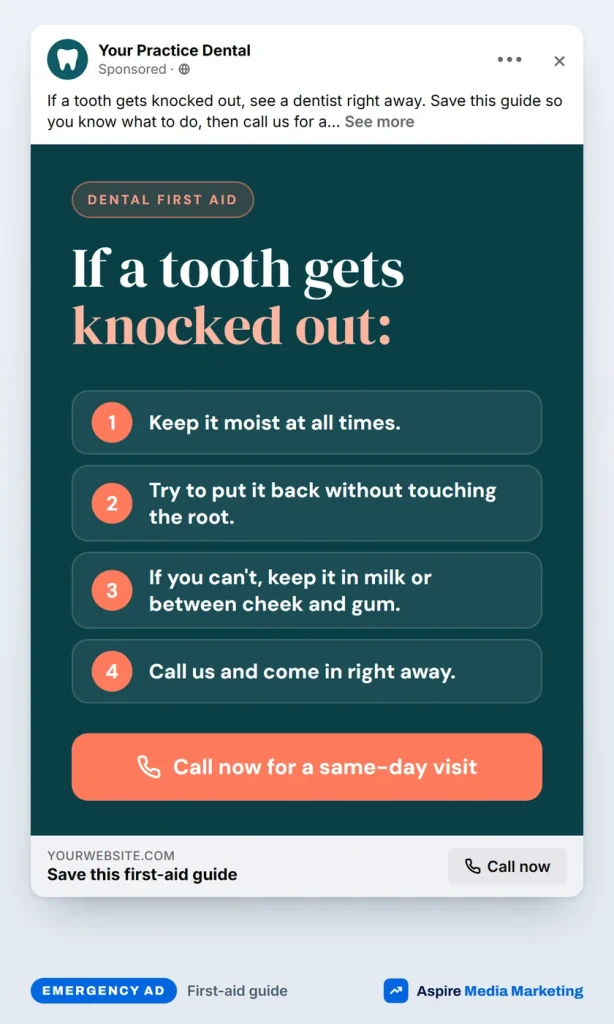
Primary text: If a tooth gets knocked out, see a dentist right away. Save this guide so you know what to do, then call us for a same-day visit.
Headline: Save this first-aid guide
Button: Call now
Format: Single image built to be saved and shared. Audience: Adults within a short drive, running all year.
Why it works: Useful content gets saved and shared, which puts your name in front of people before an emergency happens. When one does, your number is the one they already have.
Before you run it: Keep the steps in line with recognized guidance, such as the ADA’s advice on dental emergencies, and don’t promise that the tooth can be saved.
First visit ad examples
First visit ads turn people who have never been to your practice into new patients. They work best when they remove the two big unknowns: what the first visit costs and who the patient will meet.
10. New patient visit at one flat fee
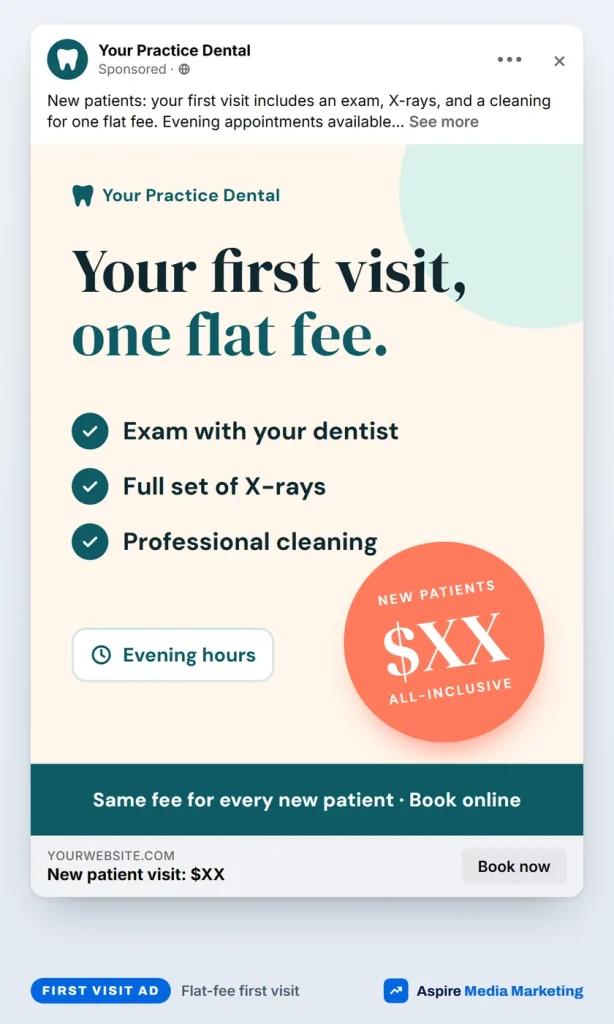
Primary text: New patients: your first visit includes an exam, X-rays, and a cleaning for one flat fee. Evening appointments available. Book online.
Headline: New patient visit: $XX
Button: Book now
Format: Single image, 4:5, Facebook and Instagram feeds. Audience: Adults who live or work within a short drive of the practice.
Why it works: The fee is the hook, and the list of what is included answers “what’s the catch?” before anyone asks. Because it is the same fee every new patient pays, it also works in Ontario, where discounts and reduced rates count as incentives.
Before you run it: In Ontario, an advertised fee must be the maximum fee, including lab costs, and it must apply to every patient, not only the people who saw the ad. Drop “free” and “% off” versions there. In the US, check your state board’s rules on advertised fees and discounts.
11. Meet-the-dentist Reel
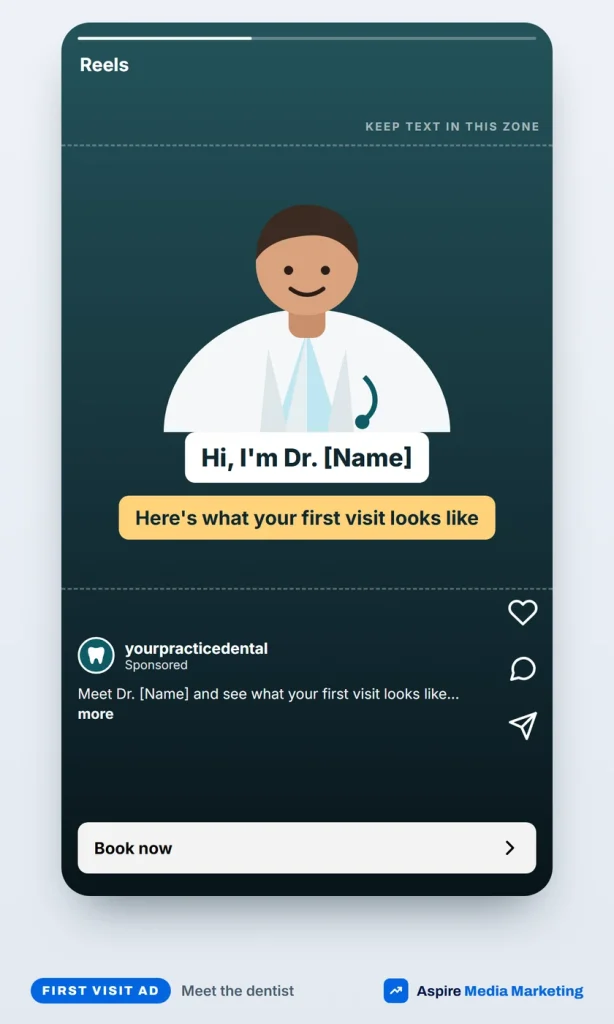
Primary text: Meet Dr. [Name] and see what your first visit looks like, from check-in to checkup, in 30 seconds.
Headline: Meet your new dentist
Button: Book now
Format: Vertical video, 9:16, for Reels and Stories. Audience: Everyone within a short drive; save the viewers as a retargeting audience.
Why it works: People want to know who they will meet before they book. Thirty seconds with the dentist does that in a way a still image cannot, and everyone who watches can be retargeted later.
Before you run it: Meta recommends keeping roughly the top 14% and bottom 35% of a 9:16 Stories ad free of text and key elements, so put captions in the middle. Film only staff and patients who have given consent. In Ontario, leave out patient testimonials and any mention of continuing education or academy memberships.
More dental Facebook ad ideas
These four round out a campaign plan. Add them once the four core campaigns are running.
12. New to the neighborhood
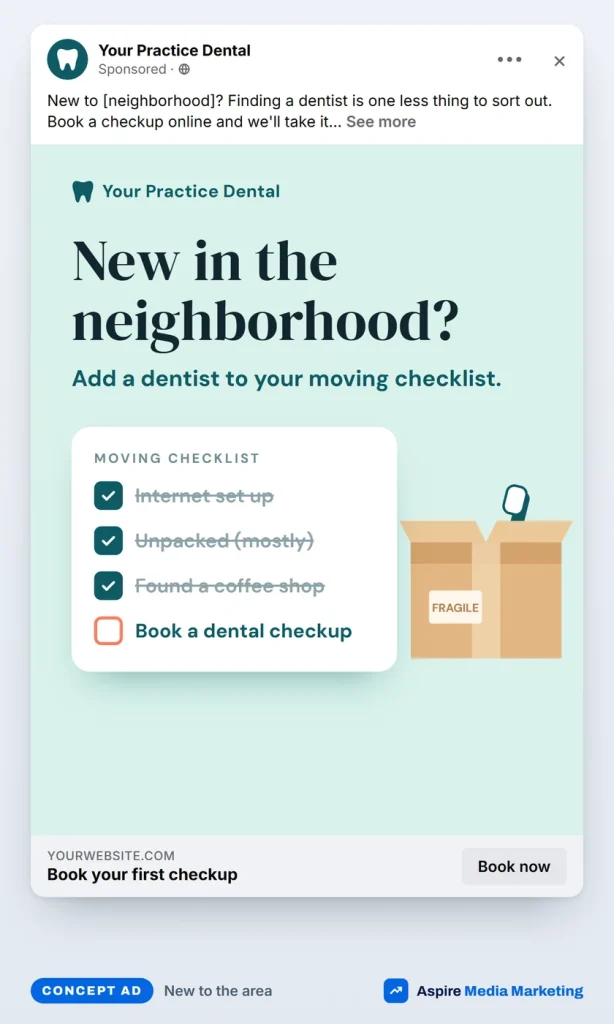
Primary text: New to [neighborhood]? Finding a dentist is one less thing to sort out. Book a checkup online and we’ll take it from there.
Headline: Book your first checkup
Button: Book now
Format: Single image, feeds and Stories. Audience: Adults in the neighborhoods closest to the practice.
Why it works: It meets a real moment. People who have just moved are setting up everything at once, and the ad turns finding a dentist into one quick task. The checklist gives the image a reason to be read.
Before you run it: Keep the question about the move, not the reader’s teeth. A hook like “Haven’t seen a dentist in years?” implies something about the reader’s health, which Meta’s personal attributes policy does not allow.
13. Family checkups, booked back to back
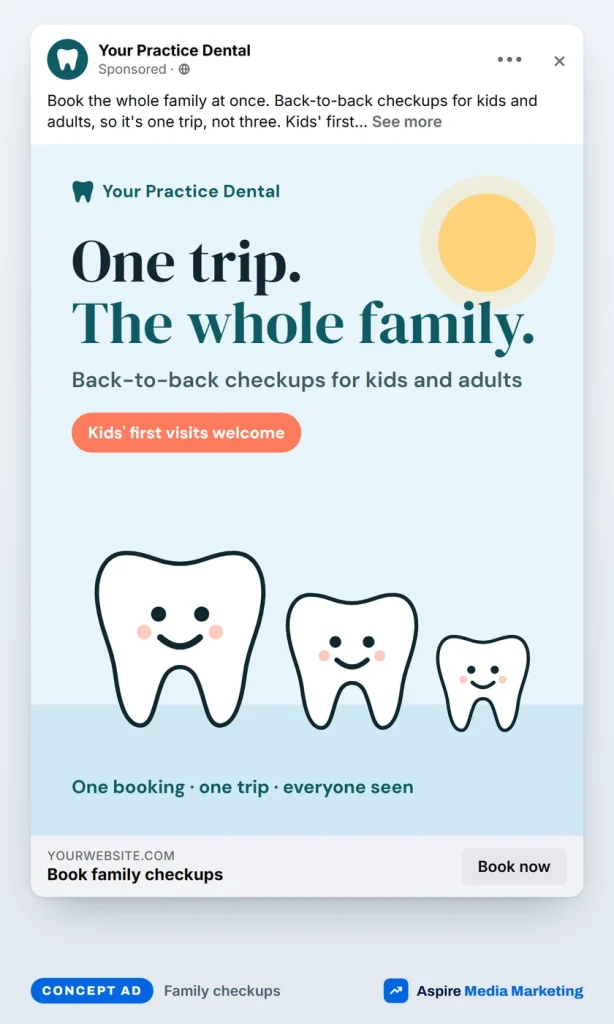
Primary text: Book the whole family at once. Back-to-back checkups for kids and adults, so it’s one trip, not three. Kids’ first visits welcome.
Headline: Book family checkups
Button: Book now
Format: Single image or a short carousel. Audience: Adults 25 to 55 within a short drive (parents are the decision makers).
Why it works: It sells convenience, which is what parents are short on. One booking can bring in several patients, so a single lead can fill several appointments.
Before you run it: Leave out prizes for kids in Ontario. A general dentist there should also not advertise as a “kids dentist” or “pediatric dentist,” because the RCDSO reserves specialty descriptions for registered specialists. “Family dentistry” is safe.
14. Professional teeth whitening
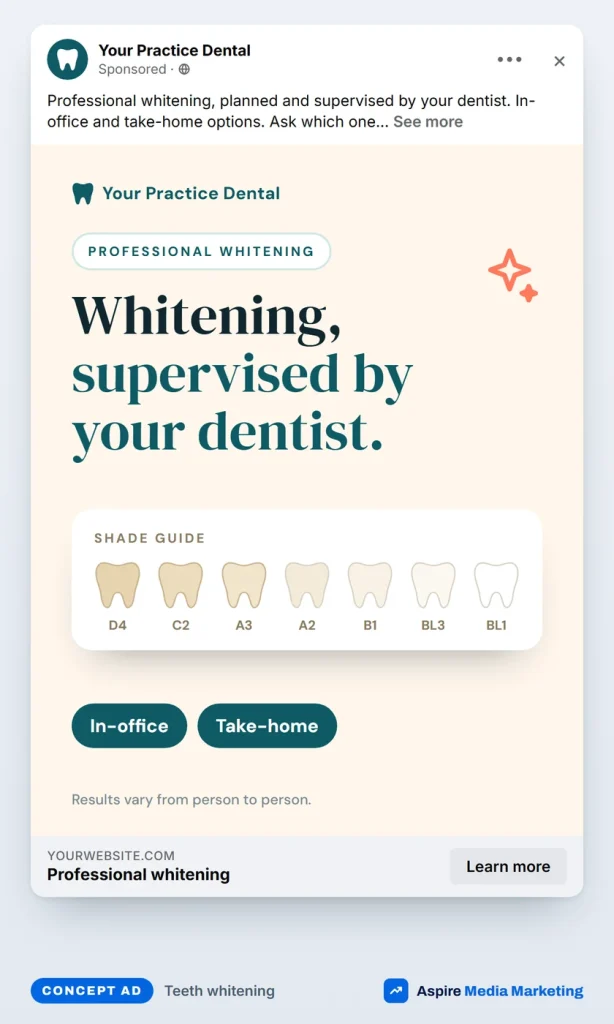
Primary text: Professional whitening, planned and supervised by your dentist. In-office and take-home options. Ask which one suits your teeth.
Headline: Professional whitening
Button: Learn more
Format: Single image, Instagram feed and Stories. Audience: Adults 18 and older within a short drive.
Why it works: “Supervised by your dentist” is the difference a drugstore kit cannot offer, and the ad makes the point without comparing itself to anyone. Offering two options invites a question instead of a yes or no.
Before you run it: Target 18 and older. Meta allows before-and-after photos for cosmetic procedures aimed at adults, but you still need the patient’s written consent, typical results, and a check against your regulator’s rules. Never open with “Tired of yellow teeth?”
15. Retargeting reminder
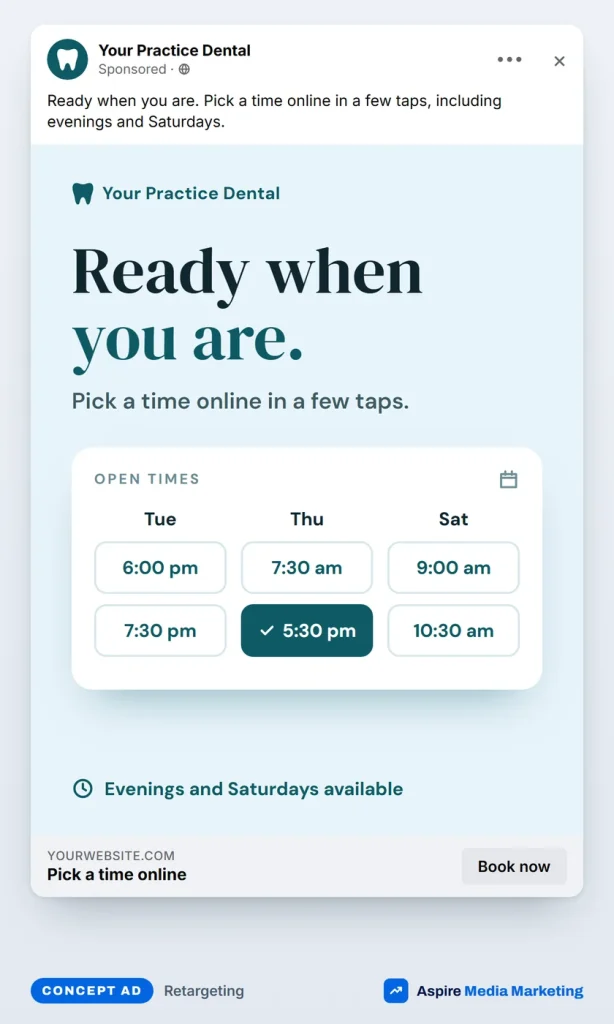
Primary text: Ready when you are. Pick a time online in a few taps, including evenings and Saturdays.
Headline: Pick a time online
Button: Book now
Format: Single image, feeds and Stories. Audience: Website visitors from the last 30 days who did not book, plus video viewers.
Why it works: It is short and friendly, and it shows the thing that often stops people from booking: finding a time. Offering evening and weekend slots answers a common scheduling objection.
Before you run it: Keep retargeting copy general. Don’t name the treatment page someone viewed, such as “Still thinking about implants?”, because it can read as an assumption about their health.
Want these ads written, designed, and run for your practice?
Dental ads that get rejected, and how to rewrite them
Meta’s ad policies trip up more dental ads than anything else. Two rules cause most of the trouble:
- Personal attributes. Meta’s Privacy Violations and Personal Attributes policy says ads must not assert or imply personal attributes, including physical or mental health. Its own example: “Do you have diabetes?” is not allowed, while “New diabetes treatment available” is.
- Negative self-perception. The Health and Wellness policy bars cosmetic ads that make statements of inferiority about physical appearance, or that use negative questions attacking a person’s appearance, body parts, or hygiene.
Here is how to rewrite the most common offenders:
| Instead of | Try |
|---|---|
| “Do you have a toothache?” Asks about a health condition | “Same-day appointments for toothaches and broken teeth.” |
| “Scared of the dentist?” Implies a mental health attribute | “Calm, unhurried appointments at your pace.” |
| “Embarrassed by your crooked teeth?” Attacks appearance | “See your clear aligner options in one consultation.” |
| “Tired of yellow teeth?” Negative about appearance | “Professional whitening, supervised by your dentist.” |
| “The best dentist in [city]” A superlative, banned in Ontario | “Family dentistry on [street], open Saturdays.” |
| “Free whitening for new patients” An incentive in Ontario | “New patient visit: one flat fee, the same for everyone.” |
Before-and-after photos are a special case. Meta’s Health and Wellness policy allows them for general cosmetic procedures when the ad is targeted to people 18 or older. You still need the patient’s written consent, results that are typical, and a check against your regulator’s rules below.
Dental advertising rules in Canada and the US
Meta’s policies are only half the check. Your regulator’s advertising rules apply to Facebook and Instagram ads in the same way they apply to your website. Here is what to look at before a campaign goes live. It is a practical summary, not legal advice.
Ontario (RCDSO)
The RCDSO’s practice advisory on professional advertising rules out testimonials, superlative or comparative terms such as “state of the art,” statements that create an expectation of favorable results or appeal to fear, and incentive programs, including giveaways, contests, draws, or free products or services. A 2025 RCDSO article adds reduced rates, bonuses, and tiered programs to the incentives to avoid. You can still advertise a fee, but it must be clearly stated, be the maximum fee including lab costs, and apply to every patient. General dentists should also not describe themselves as specialists.
British Columbia (BCCOHP)
The BC College of Oral Health Professionals’ Standards for the Oral Health Team require your team’s marketing and advertisements to be accurate and not mislead the public, and patients must consent to any use of their images or information. If you plan to run review or testimonial ads in BC, confirm the current rules with the College first.
Alberta (CDSA)
The College of Dental Surgeons of Alberta’s advertising statement centers on advertising that is truthful and not misleading. It is lighter than Ontario’s rules, but every claim in an ad still has to be accurate.
United States
Testimonials and promotions are generally allowed, but each state dental board sets its own advertising rules, so check yours. HIPAA treats identifiable patient photos as protected health information, which means before-and-after photos and patient videos need the patient’s written authorization before they appear in an ad.
Practices in other provinces and states should check their own regulator’s rules the same way.
Targeting, tracking, and landing pages
Keep targeting simple. For most local practices, a radius around the office and an age range that fits the offer is enough, with 18 and older for anything cosmetic. Let the creative do the filtering.
Tracking is where dental advertisers hit a newer limit. Meta assigns categories to the websites and apps that share data with it, and its Health and wellness category covers businesses associated with provider and patient relationships. Some categories come with extra data-sharing restrictions, which can limit the website events your ads are able to optimize for. Check how your website is categorized in Meta Events Manager before you build a campaign around website bookings.
That is also why the destination matters. You have two good options:
- A landing page that repeats the ad’s offer and has one booking form. It gives you room to answer questions about cost, timing, and what to expect.
- An Instant Form that opens inside Facebook or Instagram. It is quicker for the patient, but the lead has not seen your website yet, so call it back fast.
Whichever you choose, measure cost per booked patient, not just cost per lead. A cheap lead who never answers the phone costs more than a pricier one who books.
How much dentist Facebook ads cost
Dental clicks are expensive on Facebook. LocaliQ’s 2026 Facebook advertising benchmarks report these averages for lead campaigns in the Dentists and Dental Services category, compared with the average across all industries:
| Benchmark | Dental | All |
|---|---|---|
| Click-through rate | 1.62% | 2.70% |
| Cost per click | $5.70 | $1.80 |
| Conversion rate | 6.07% | 8.54% |
| Cost per lead | $61.56 | $27.39 |
A dental lead costs more than twice the cross-industry average, so the offer and the landing page carry more weight than they do for most businesses. For comparison, WordStream’s 2026 Google Ads benchmarks put the average cost per lead for dentists at $72.97 on search.
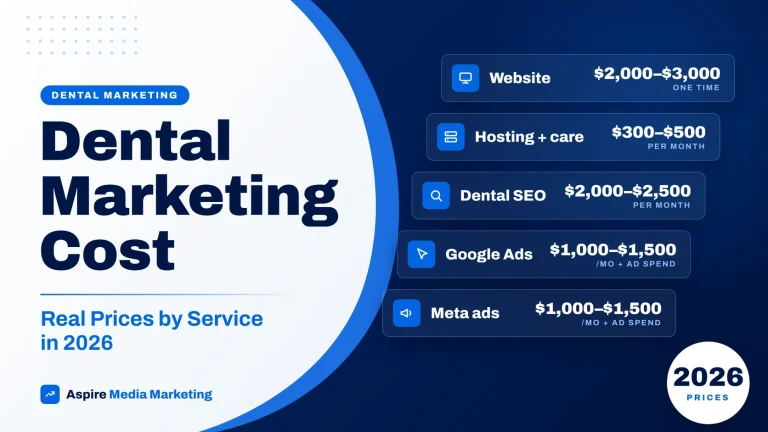
Most dental clinics start with $1,000 to $2,500 a month in ad spend, plus a management fee, and some scale to $5,000 to $10,000 or more once they find ads that work. At Aspire, managing Meta ads costs $1,000 to $1,500 a month, with ad spend paid separately. Our dental marketing cost guide breaks down every line item.
Give a new campaign time to learn. Most clinics see their first leads within 7 to 14 days of launch, and booked appointments typically settle by weeks 4 to 6.
Facebook ads or Google Ads for dentists?
They do different jobs. Google Ads for dentists reach patients who are already searching, which suits emergencies and urgent care. Facebook and Instagram ads reach people who were not searching yet, which suits planned treatment like checkups, clear aligners, whitening, and implants. The best-performing clinics we work with run both: Google catches demand, and Meta creates it. Our guide to digital marketing for dentists shows how the channels fit together.
Ads do not depend on your follower count, but a clean profile with a few recent posts reassures the people who click through to your page. For the organic side, see our dental social media post ideas or our dental social media marketing service.
Frequently asked questions
Do Facebook ads work for dentists?
Yes, when the ad leads with a clear offer or answer and sends people to one booking step. Facebook and Instagram ads reach people who were not searching yet, so they suit planned treatment like checkups, clear aligners, whitening, and implants. Most clinics see their first leads within 7 to 14 days of launch.
What should a dental Facebook ad say?
One clear message: what you offer, who it is for, and the next step. Meta recommends 50 to 150 characters of primary text for feed image ads and a headline of about 27 characters. Describe the service instead of asking about the reader’s health or appearance.
Can dentists use before-and-after photos in Facebook ads?
Meta allows before-and-after images for general cosmetic procedures when the ad is targeted to people 18 or older. You also need the patient’s written consent, results that are typical, and a check against your regulator’s advertising rules.
How much should a dentist spend on Facebook ads?
Most dental clinics start with $1,000 to $2,500 a month in ad spend, plus a management fee. At Aspire, Meta ads management costs $1,000 to $1,500 a month. Some practices scale ad spend to $5,000 to $10,000 or more once they find ads that work.
What is a good cost per lead for dental Facebook ads?
LocaliQ’s 2026 Facebook ads benchmarks put the average cost per lead for dentists and dental services at $61.56, compared with $27.39 across all industries. A good cost per lead is one that turns into booked patients at a profit, so track cost per booked patient as well.
Are Instagram ads for dentists different from Facebook ads?
They run from the same Meta Ads Manager, so one campaign can serve both. The main difference is the format: Instagram Stories and Reels are vertical (9:16), so make a vertical version with the key text away from the top and bottom edges.
Where to start
If you are new to dental Facebook ads, start with the campaign that matches your most valuable treatment: Invisalign (examples 1 to 4) or implants (examples 5 to 7). Pair it with a first visit ad (example 10) and the retargeting reminder (example 15), then add the emergency ads. Run every ad past Meta’s rules and your regulator’s rules before launch.
Want a team to write, design, and manage them for you? See how our Meta ads management for dentists works.
Ready to grow your dental practice?
Get a free, no-obligation strategy session and a custom growth plan for your practice.
Book Your Free Call →Keep Reading