Search for dental marketing ideas and you get lists. Fifty tactics, no order, no way of knowing which one applies to you. Most of them were written for a practice that is not yours, and a few of them are not legal where you work.
This list is ordered by the problem each idea fixes. A practice that nobody can find has a different problem from one that gets found and never gets called, and both are different again from a practice with a full appointment book and a quiet hygiene department. Most dental marketing strategies fail not because the tactic was wrong but because it was aimed at a step that was already working. The best dental marketing ideas are simply the ones pointed at the step that is actually broken.
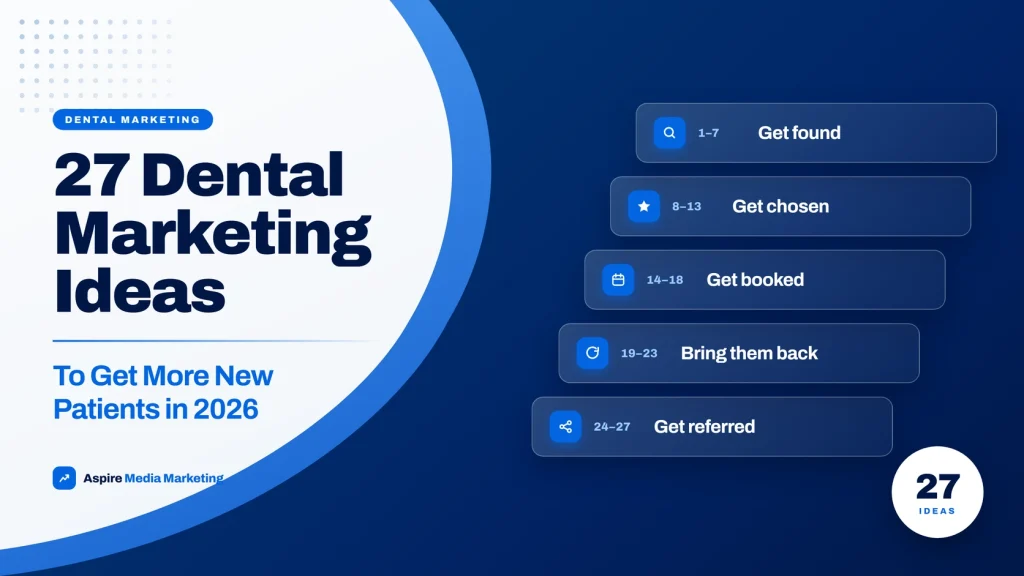
Twenty-seven ideas follow, in five groups, with a plan for sequencing them at the end. If you would rather see this organised by channel, we have written that version too: digital marketing for dentists.
How to use this list of dental marketing ideas
Before adding anything, work out where patients are being lost. Take a month and count four numbers: how many people saw the practice, how many contacted it, how many booked, and how many arrived. The gap between two of those numbers will be much larger than the others. That gap is your bottleneck, and it decides which group below you read first.
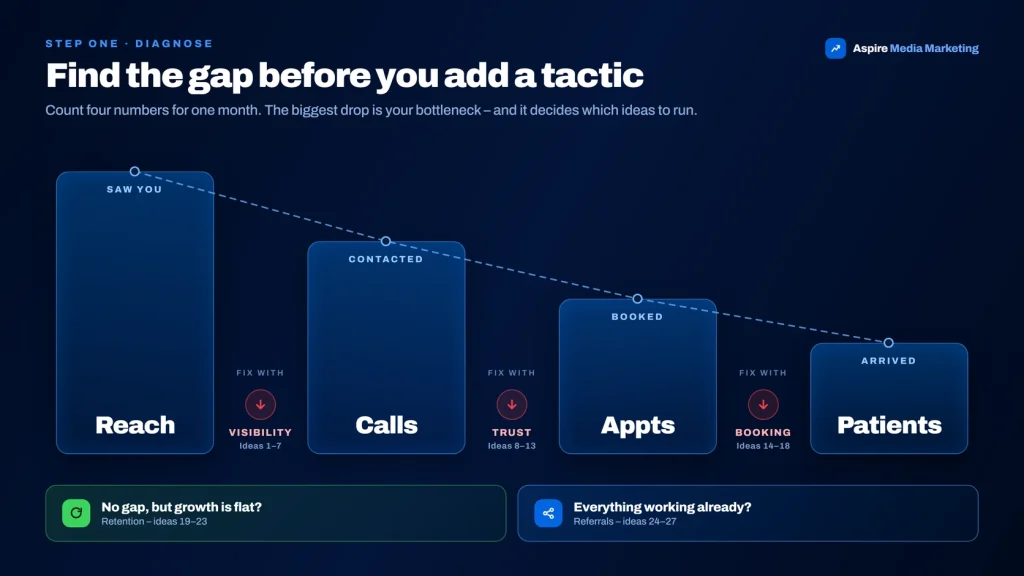
| If this is the gap | The job to fix | Go to |
|---|---|---|
| Very few people see the practice at all | Visibility | Ideas 1 to 7 |
| People see it, almost nobody contacts it | Trust | Ideas 8 to 13 |
| People call or start a form and drop out | Booking | Ideas 14 to 18 |
| Patients book once and are never seen again | Retention | Ideas 19 to 23 |
| Everything works but growth has flattened | Referrals | Ideas 24 to 27 |
Working in that order matters. Sending more traffic to a website that does not convert is the most expensive mistake in dental practice marketing, and it is the one most often recommended. It is also why generic dental clinic marketing ideas rarely survive contact with a real practice: without knowing which step is leaking, every suggestion is a guess. The marketing ideas for dental practices that are worth your time are the ones you can trace to a number that is currently disappointing.
First, the advertising rules that quietly rule out half the advice online
Dental advertising is regulated, and the rules differ sharply by jurisdiction. A great deal of the dentist advertising ideas circulating online were written in the United States and are not safe to run in Ontario.
Ontario. The Royal College of Dental Surgeons of Ontario prohibits testimonials in advertising, along with superlative and comparative claims, statements that create an expectation of favourable results, and incentive programs including giveaways, contests and draws. Its guidance also treats posts from an account that identifies its holder as a dentist as advertising. The primary source is the RCDSO Practice Advisory on Professional Advertising.
Alberta. The College of Dental Surgeons of Alberta is materially lighter. Its advertising statement does not prohibit testimonials, superlatives or incentives; what binds is the requirement that advertising be truthful and not misleading.
United States. Identifiable patient images are protected health information under HIPAA, and marketing use requires written patient authorisation. Testimonials and contests are generally permitted subject to the state board.
Check your own regulator before running anything in this list that involves a patient’s words, a patient’s face or a prize. Where a rule applies, it is noted with the idea.
Get found: dental marketing ideas for new patients who have never heard of you
This group is for practices whose problem is visibility. The aim is not traffic in the abstract – it is being present at the two moments a patient is actually choosing: the map pack, and the page about the treatment they need.
1. Give every treatment its own page
The single most common structural problem on a dental website is one services page listing fourteen treatments as bullet points. Google has nothing to rank and the patient has nothing to read. Every treatment you actually want to be known for needs its own page with its own heading, its own explanation of what the appointment is like, and its own booking button. Start with the treatments that matter most to the practice, not the ones that are easiest to write. Our dental website development work almost always begins here, because nothing else in this list works properly until it is done.
2. Win your own city before you chase the bigger one next door
Proximity is a real and stubborn factor in local results, so a practice in a smaller town rarely outranks the practices physically inside the larger city nearby. Own the city you are actually in first: the searches there are less contested, the patients are closer, and they show up. Once you are consistently in the map pack at home, a neighbouring-city page becomes a reasonable next step rather than a wasted one. The mechanics are in our guide to local SEO for dentists.
3. Answer the "near me" question properly
Nobody optimises for the literal phrase. What Google is doing with a near-me search is picking businesses whose profile, category, reviews and website all agree about what they are and where they are. That means the primary category on the Google Business Profile has to be right, the practice name and address have to match everywhere they appear, and the website has to say the city in ordinary sentences rather than in a stuffed footer. This is unglamorous work and it moves more than most campaigns.
4. Put your fees, or an honest range, on the page
Cost is the first thing a patient wants and the last thing most practices publish. You do not have to post a price list. You do have to explain what determines the fee, what a typical case looks like, and what happens at the consultation. A page that answers the money question gets called by people who have already accepted the number, which changes the quality of the calls the front desk takes far more than it changes the quantity.
5. Turn one long treatment page into a hub and spokes
Where a treatment is genuinely complex, one page cannot carry every question. Keep the main page as the hub that sells the treatment, then write separate pages or posts for the specific questions people search – what it costs, how long it takes, what the recovery is like, how it compares to the alternative. We used exactly this pattern for dental implant marketing and Invisalign marketing, where the head term alone was never going to carry the whole topic. Structuring a topic this way is the bulk of what dental SEO actually consists of.
6. Get listed where the roundups already rank
For competitive commercial searches, the results are increasingly lists of practices rather than practices. Being included in a credible local roundup, a professional directory or a chamber listing can put you on a page you would struggle to outrank on your own. Start with the listings that already appear when you search for a dentist in your city, and work down the page. This is slow, unexciting and durable.
7. Write for the answer, not just the blue link
A growing share of dental questions are answered above the results, and by assistants that never show a list at all. The content that gets used in those answers tends to be plainly written, structured under real questions, specific about place and price, and attributed to a named clinician. Writing that way costs nothing extra and it is the same writing that performs well in ordinary search, which is why it belongs in a list of ideas rather than in a separate strategy.
Get chosen: what turns a search result into a phone call
These are the creative dental marketing ideas that cost the least and are skipped the most, because none of them involve buying anything. They all do the same job: making a stranger believe that this practice is a safe place to take a problem.
8. Reply to every review, including the five-star ones
Replies are public. The patient reading them is not the patient who wrote them, and what they are measuring is how a practice behaves when something goes wrong. A short, specific, non-defensive reply to a complaint does more for the next booking than the complaint does against it. Replying to positive reviews matters too, because a wall of unanswered praise reads as an absent owner.
9. Deal with the reviews that should not be there
Rating damage is not always earned. Duplicate reviews, reviews left on the wrong practice, and obvious spam can be reported, and when they are removed the rating moves. It is worth auditing the review profile properly once rather than assuming the number is fixed, particularly where a practice has two locations and the profiles have been merged or split at some point.
10. Photograph the actual practice
Stock photography of a model in a chair tells a patient nothing and every practice has the same one. Photographs of your reception, your operatories, your equipment and your team answer the question a nervous patient is actually asking, which is what it will feel like to walk in. This is one of the cheapest changes on this list and one of the few that improves the website, the Google Business Profile and social at the same time. It is also the single thing the best dental websites we reviewed had in common.
11. Name the dentist on every treatment page
Search engines and patients both want to know who is doing the work. A treatment page that names the clinician, says what they trained in and links to their bio is more credible than the same page written anonymously. It also gives you something to say that a competitor cannot copy, which is rarer in dental content than it should be.
12. Answer the fear, not just the procedure
Most dental pages describe a procedure. Very few describe what happens if the patient is frightened. Say plainly what is available for an anxious patient, how freezing is handled, what the appointment sounds like, and what someone should tell you when they book. Only describe options your practice genuinely offers – a page that promises comfort measures you do not provide creates a complaint on the day.
13. Show results, within the rules that apply to you
Before-and-after photography is persuasive and it is regulated differently depending on where you practise. In the United States, identifiable patient images are protected health information and marketing use needs written patient authorisation. In Ontario, testimonials are not permitted at all, which rules out the patient-quote format that most templates default to. Build the format that is legal where you are rather than the one that looks best in a competitor’s portfolio.
Get booked: dental office marketing ideas for the last ten seconds
Everything above this point is spent at the moment a patient tries to make contact. These five marketing ideas for dental offices are about not losing them there, and they are the dental office marketing strategies with the shortest gap between doing the work and seeing the result.
14. One call to action per page
A page offering a call, a form, a chat widget, a phone number and a newsletter signup is a page asking the patient to make a decision about how to decide. Pick the single action you want from that page and repeat it. Everything else is a distraction dressed as helpfulness.
15. Make the phone work on a phone
The majority of dental searches happen on a mobile device, and a surprising number of dental websites still present the number as plain text, bury it in an image, or put it only in the footer. It should be tappable, it should be visible without scrolling, and the hours beside it should be the hours you are actually open, including the ones over a holiday.
16. Put booking where the patient already is
A patient who finds you in the map pack is inside Google, not on your website. A booking link on the Google Business Profile lets them finish there instead of navigating to a site and starting again. Every extra screen between the decision and the appointment costs you some of the people who had already decided.
17. Cut the form down to what you will actually use
Long forms are a habit, not a requirement. Ask for the fewest fields you need to call the person back, and collect the rest on the phone or at the visit. Insurance details, full addresses and dates of birth on a first-contact form are a reason for a nervous patient to close the tab.
18. Find out what happens when nobody answers
Ring your own practice at lunchtime, at five past five, and on a Saturday morning, and listen to what a new patient hears. Whatever you spend on being found is spent again every time that call goes unanswered and unreturned. Fixing this usually costs nothing and it is the step most often skipped, because it is the only idea on this list that is uncomfortable to test.
Bring them back: the cheapest new patient you will ever get
Acquisition gets the attention and retention pays for it. If the practice has been open more than a few years, the list of former patients is usually larger than a year of new ones, and it costs a fraction as much to reach.
19. Reactivate the patients you already have
Every practice has a list of people who were patients and quietly stopped coming. They already trust you, they are already in the software, and reaching them costs a fraction of what a new patient costs. Pull everyone not seen in eighteen months and contact them with a specific reason to return rather than a generic reminder that they are due.
20. Send email that is not a newsletter
Dental newsletters are written for the practice and read by nobody. Email that works is short, triggered by something real – a treatment discussed and not booked, a recall coming up, a seasonal benefits deadline – and it asks for one thing. Volume is not the lever here; relevance is.
21. Name the treatment in the recall reminder
A reminder saying the patient is due for a cleaning competes with everything else in their week. A reminder that refers to the cracked filling the dentist pointed out at the last visit is a different message entirely, because it repeats something the patient already remembers being told. Only reference what is genuinely recorded in the chart, and only where your software can pull it reliably.
22. Track the patients who booked and never arrived
No-shows and cancellations are usually counted as a scheduling problem and almost never as a marketing one, which is why nobody measures what they cost. Count them for a month. If the number is meaningful, a confirmation sequence and a short, human follow-up call will recover more appointments than the equivalent spend on advertising would create.
23. Treat the Google Business Profile as a channel, not a listing
Profiles that are updated – posts, new photographs, current hours, services kept accurate – behave differently from profiles that were completed once in 2019. Google retired the Business Profile question-and-answer feature, so the remaining surfaces carry more weight than they used to. There is a full walkthrough in our local SEO guide, and the same discipline applies to social media: a channel or nothing. If the blocker is simply not knowing what to post, we published fifty dental social media post ideas with captions you can copy.
Get referred: dental referral marketing that does not rely on luck
Referrals are treated as something that either happens or does not. They are more reliably treated as a system with three parts: asking at the right moment, being easy to describe, and being present in the places your neighbours already look.
24. Ask at the right moment, and make it one tap
The best time to ask for a review is while the patient is still in the practice and pleased, not three days later by email. A short link or a QR code at the front desk turns a good moment into a review; a card with a long URL turns it into an intention. Ask everyone, not only the cases that went unusually well, because a rating built from ordinary visits is more robust than one built from highlights.
25. Give referring practices something to refer to
If you take referrals from other dentists, the referral is easier to make when there is a page explaining exactly what you do, what you need from them, and what the patient will be told. Most practices that want referrals have never built that page, which means the referring office is left describing you from memory.
26. Be in your own community's listings
Chamber of commerce pages, business improvement area directories, local sports sponsorships and school newsletters are not glamorous and they are genuinely local. They produce links that are hard for an out-of-town competitor to copy and they put the practice name in front of the people who live closest to it.
27. Make your best explanation easy to hand over
Patients refer by sending something. A clear page about the treatment their friend is worried about is more likely to be forwarded than a homepage. If you have written one genuinely good explanation of the thing people ask about most, that page is doing referral work every time it is shared, which is the quietest form of dental referral marketing there is.
Turn these ideas into a dental marketing plan
Twenty-seven ideas is a list, not a dental marketing plan. What turns one into the other is sequence, because several of these depend on work done earlier. Dental marketing strategies are sequenced, not stacked, and the order below assumes a practice starting from an ordinary position rather than a crisis.
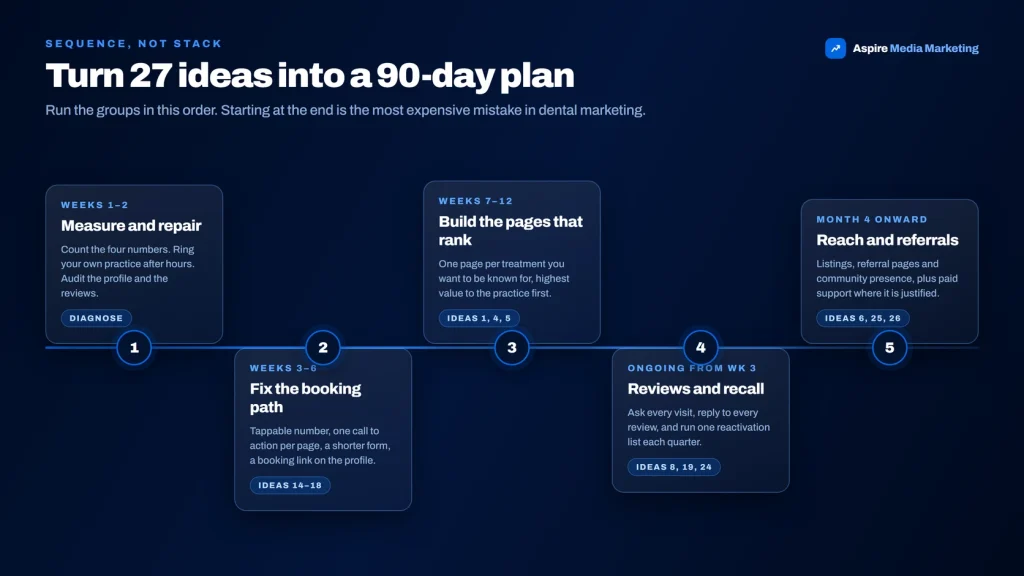
| Weeks | Focus | What gets done |
|---|---|---|
| 1 to 2 | Measure and repair | Count the four numbers. Ring your own practice after hours. Audit the review profile and the Google Business Profile categories, hours and contact details. |
| 3 to 6 | Fix the booking path | Ideas 14 to 18. Tappable number, one call to action per page, shorter form, booking link on the profile. |
| 7 to 12 | Build the pages that rank | Ideas 1, 4 and 5. One page per treatment you want to be known for, starting with the highest value to the practice. |
| Ongoing from week 3 | Reviews and recall | Ideas 8, 19 and 24. Ask every visit, reply to every review, and run one reactivation list a quarter. |
| Month 4 onward | Reach and referrals | Ideas 6, 25 and 26, plus paid support where a treatment justifies it. |
Two things make this fail. The first is starting at the bottom, because reach is the most visible work. The second is running all five groups at once, which makes it impossible to tell which change did anything.
What these dental marketing ideas actually cost
Rather than quote figures that vary by market, it is more useful to sort these dental marketing tips by what they take out of the practice. Most of the highest-return items on this list cost attention rather than money.
| Cost | Ideas | What it really takes |
|---|---|---|
| Nothing but time | 3, 8, 11, 12, 15, 17, 18, 21, 24 | An afternoon of someone’s attention and a decision to keep doing it. |
| Small and one-off | 10, 16, 25, 26 | A photographer for a morning, a booking link, one page written, a few listings claimed. |
| Sustained internal effort | 1, 4, 5, 19, 20, 22, 23 | Someone owning it weekly. This is where most practices stall, and where an agency usually earns its place. |
| Budget required | 6, 7, plus paid media | Ongoing spend, and worth starting only once the booking path is repaired. |
Paid media belongs in the last row for a reason: it multiplies whatever the booking path already does, which is why Google Ads for dentists works well for a practice that has finished the first three rows and poorly for one that has not.
If you would rather not own the sustained items internally, that is what our dental marketing services exist to carry. If you are comparing providers, we have also published an honest look at the dental marketing agencies in this market, including the questions worth asking before signing anything.
How to tell whether your dental marketing is working
A dental marketing strategy is only as good as the number you judge it by. Rankings and impressions are the two most often reported and the two least connected to a full appointment book. A practice can improve its average position for a year and take the same number of calls, because the results that matter locally sit in the map pack rather than in the ordinary list.
Four measures are worth keeping instead:
- Calls and form submissions from search, counted at the source rather than estimated.
- New patients who arrived, not appointments booked – the gap between those two is the no-show cost from idea 22.
- Review count and rating over time. A flat review count is the clearest early sign that the asking habit has quietly stopped.
- Reactivated patients per quarter, which is the only one of the four that the practice controls entirely on its own.
One caution worth knowing: Google Search Console does not report clicks that happen inside the map pack. A practice can be doing well in local results and see very little of it in the search report, which is why the profile’s own performance data has to be read alongside it.
Frequently asked questions
What is dental marketing?
Dental marketing is everything a practice does to be found by patients who need care, to be chosen over the practice down the road, and to keep the patients it already has. In practice that means four jobs: visibility in search and the Google map pack, trust signals such as reviews and real photography, a booking path that works on a phone, and recall and referral systems that bring existing patients back. It is not one channel. A practice can rank well and still lose patients at the booking step, or convert beautifully and never be seen.
How do you do marketing for a dental clinic?
Start by finding which of the four jobs is broken rather than adding a new channel. Count how many people saw the practice, how many called or booked, and how many became patients. If very few people see you, the problem is visibility and the fix is the Google Business Profile and service pages. If plenty see you but few call, the problem is trust or the booking path. If people book and never arrive, the problem is confirmation and reminders. Fix the broken step first, because work spent on any other step is wasted until it is repaired.
How do you get more dental patients?
The fastest source of new dental patients is usually the map pack, because that is where someone searching for a dentist nearby actually looks. Claim and complete the Google Business Profile, choose the right primary category, ask every happy patient for a review and reply to each one, and make sure the phone number and hours are correct. After that, give each treatment you want to be known for its own page rather than a bullet on a single services page. Those two pieces of work cover most of the gap for a practice that is not being found.
How do you attract new dental patients?
Attracting new dental patients is a question of matching what people are worried about before they book. Most of that worry is cost, pain and time off work, and most dental websites answer none of it. Publish a fee range or a clear explanation of what determines the fee, say plainly how a nervous patient is looked after, show the actual practice rather than stock photography, and name the dentist who provides the treatment. Practices that answer the awkward questions on the page get called by patients who have already decided.
How do you get more patients in a dental office that is already busy?
A busy office usually has more to gain from retention than from acquisition. Run a list of patients who have not been seen in eighteen months and contact them with a specific reason to return rather than a generic reminder. Track the patients who booked and never arrived, because that number is normally larger than anyone expects and it is cheaper to recover than to replace. Then make sure the treatments with the highest value to the practice have their own page and their own follow-up, instead of being mentioned once during a hygiene visit.
Where to start
Pick the gap, not the idea. Count the four numbers for a month, find the step where the biggest drop happens, and run only the group of dental marketing ideas that fixes it. One repaired step beats five started ones, and it is the difference between a list of tactics and a plan that will actually grow your dental practice. That is what dental practice growth looks like in practice: fewer things, finished.
If you would like a second read on which step is actually costing you patients, book a call and we will go through the numbers with you.
Ready to grow your dental practice?
Get a free, no-obligation strategy session and a custom growth plan for your practice.
Book Your Free Call →Keep Reading