Dental SEO keywords are the words patients type into Google when they need a dentist, a treatment, or an answer about one. Pick the right ones and every page on your site gets a clear job: the homepage goes after your city, each service page goes after one treatment, and the blog answers the cost and comparison questions people ask before they book.
This guide lists 66 real dental keywords with monthly search volume for the US and Canada and a difficulty score, grouped by service: dental implants, Invisalign, cosmetic, emergency, and general dentistry, plus near me and city searches. Every number comes from keyword research we ran in Ahrefs for the dental practices we work with, so you are looking at the same data we use to plan their pages, not a recycled list of SEO keywords for dentists.
Quick answer: the strongest dental SEO keywords pair a treatment you sell with the place you sell it, like “dental implants toronto” (1,100 searches a month in Canada, difficulty 0). Next come cost and comparison questions such as “veneers cost” (34,000 a month in the US, difficulty 1), which belong on your blog. Generic “dentist + city” terms are the hardest to win (difficulty 58 to 68 in our data), and near me searches are won through your Google Business Profile, not your page copy.
Where these keyword numbers come from
We pulled these numbers from Ahrefs in late September and early October 2026, using its US and Canada databases, while building blog and service page plans for dental practices in both countries. Here is how to read the tables:
- Searches/mo is Ahrefs’ estimate of average monthly searches for that exact phrase in that country. A city keyword only counts searches that include the city name.
- Difficulty is Ahrefs’ keyword difficulty, a 0 to 100 score that estimates how hard it is to reach the first page, based on how many websites link to the pages ranking there now. A low score is not a promise of rankings.
- n/a means the keyword was not in our data for that country. It does not mean nobody searches it.
- Use the numbers to compare keywords with each other, not as a traffic forecast. Volumes move with the seasons.
The four kinds of dental SEO keywords
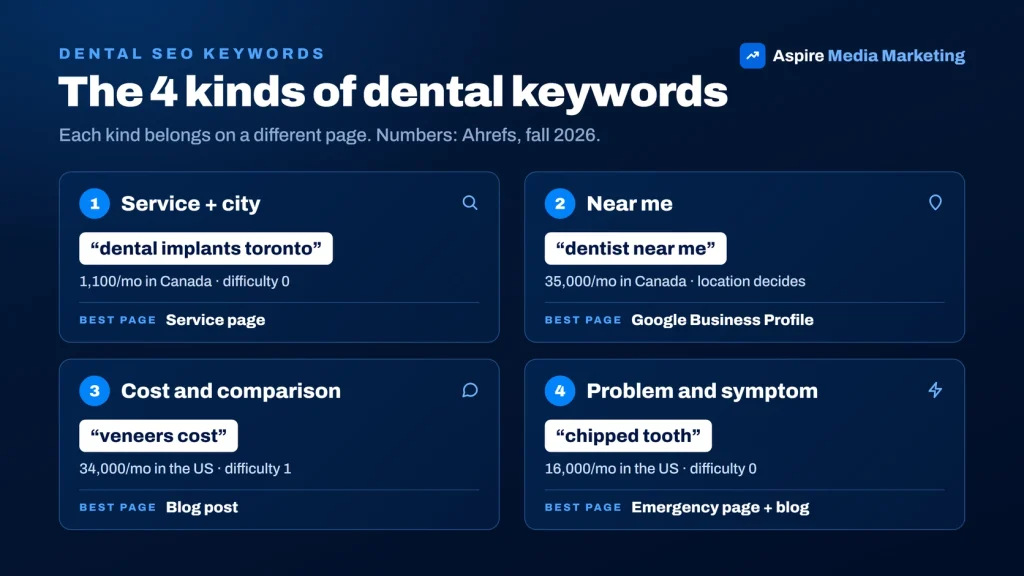
Almost every dental keyword falls into one of four kinds, and each kind belongs on a different page. Get this right first and the keyword lists below become a page plan instead of a spreadsheet.
Service + location
A treatment plus a place: “dental implants toronto”, “invisalign cost surrey”, “emergency dentist scarborough”. These carry the most buying intent of any dental keyword, because the person has already chosen the treatment and is choosing the practice. They belong on your service pages, and on location pages if you have more than one office.
Near me
“dentist near me”, “pediatric dentist near me”, “braces near me”. The searcher’s location decides who shows up, so these are won mostly in the map results through your Google Business Profile, not by writing the phrase on a page.
Cost and comparison
“veneers cost”, “root canal cost”, “dental bridge vs implant”. People are still deciding, the volumes are large, and the difficulty is often low. These are the natural job for your blog, with each post linking to the matching service page.
Problem and symptom
“toothache”, “chipped tooth”, “broken tooth”. Patients in pain search the problem, not the treatment. These feed your emergency page and short guides that tell people what to do and how fast to call.
There is a fifth kind, searches for your practice name, but you earn those through reputation and word of mouth rather than keyword targeting. Make sure your homepage title and Business Profile use the exact name patients know you by.
Dental implant keywords
Implant searches are among the biggest in dentistry, and implant cases are among the most valuable a general practice sells. The head term “dental implants” gets 252,000 searches a month in the US, but it carries a difficulty of 41 and most of those searchers are still reading, not booking.
The opening is in cost. Look at two ways of asking the same question: “dental implants cost” (41,000 a month, difficulty 34) and “cost of dental implants” (27,000 a month, difficulty 0). One well written cost guide can cover both phrasings naturally, which is far easier than winning the head term. Full arch searches are worth a separate look too: “full mouth dental implants” gets 64,000 a month at difficulty 8.
| Keyword | US searches/mo | Canada searches/mo | Difficulty (US) |
|---|---|---|---|
| dental implants | 252,000 | 5,600 | 41 |
| full mouth dental implants | 64,000 | 400 | 8 |
| dental implants cost | 41,000 | n/a | 34 |
| full mouth dental implants cost | 28,000 | n/a | 7 |
| cost of dental implants | 27,000 | n/a | 0 |
| tooth implant | 27,000 | 1,200 | 0 |
| denture implants | 9,300 | 600 | 4 |
| same day dental implants | 4,400 | n/a | 4 |
| dental bridge vs implant | 3,500 | 350 | 0 |
| all on 4 dental implants cost | 2,700 | n/a | 0 |
| dental implant procedure | 2,400 | 350 | 62 |
In Canada the volumes are smaller but the local terms are open: “dental implants toronto” and “dental implants calgary” each get about 1,100 searches a month with a difficulty of 0, and “dental implant cost” gets 1,100 nationally. Put “dental implants [your city]” on the implant service page, and give the cost, the bridge comparison, and implant dentures their own blog posts. A term like “dental implant procedure” (difficulty 62) means the pages ranking now have links from many websites, which a practice blog rarely matches, so answer it on the service page for patients rather than chasing it. For the wider plan, see our dental implant marketing service.
Invisalign and orthodontic keywords
“invisalign cost” is one of the largest low difficulty keywords in all of dentistry: 69,000 searches a month in the US at a difficulty of 0. In Canada the brand name alone gets 32,000 searches a month, and “invisalign cost canada” gets 1,200. Canadians also search “invisalign vs braces cost” more than Americans do in our data (3,300 a month against 1,600), so a comparison post earns its place on a Canadian site.
| Keyword | US searches/mo | Canada searches/mo | Difficulty (US) |
|---|---|---|---|
| invisalign cost | 69,000 | n/a | 0 |
| invisalign before and after | 18,000 | 3,000 | 0 |
| how long does invisalign take | 7,200 | 500 | 0 |
| invisalign attachments | 4,700 | n/a | 0 |
| invisalign for teens | 3,300 | 400 | 0 |
| invisalign for adults | 1,500 | 100 | 0 |
Invisalign is a trademark of Align Technology, so only target it if you are a provider, and describe your provider status exactly as it appears on Align’s own site. The before and after and “how long” searches make strong blog posts if you have consented patient photos and real treatment times to show. Our Invisalign marketing page covers how these keywords fit with ads and reviews.
Cosmetic dentistry keywords
“teeth whitening” looks like the prize at 222,000 searches a month in the US, but its difficulty is 68 and many of those searchers want a product, not a dentist (“best teeth whitening product” alone gets 2,200 a month). “professional teeth whitening” is the better target: 27,000 a month in the US at difficulty 0, and the searcher already wants it done in a chair.
| Keyword | US searches/mo | Canada searches/mo | Difficulty (US) |
|---|---|---|---|
| teeth whitening | 222,000 | 12,000 | 68 |
| veneers cost | 34,000 | 1,100 | 1 |
| professional teeth whitening | 27,000 | 1,100 | 0 |
| dental veneers | 21,000 | 1,100 | 0 |
| how much are veneers | 21,000 | 600 | 14 |
| composite veneers | 18,000 | 1,200 | 0 |
| gummy smile | 15,000 | 1,700 | 0 |
| bonding teeth | 5,000 | 400 | 7 |
| how much does teeth whitening cost | 3,500 | 300 | 0 |
Watch for two names for one treatment. In Canada, “composite bonding” gets 2,400 searches a month at difficulty 1, while “dental bonding” gets 2,000 at difficulty 19. Use both on the bonding page, in the heading and the copy, so you catch either phrasing. The same goes for “veneers cost” and “how much are veneers”: one page, both phrasings.
Emergency dentist keywords
People in pain rarely type “emergency dentist” first. They type the problem: “toothache” (38,000 a month in the US), “chipped tooth” (16,000), “broken tooth” (10,000), all at a difficulty of 0 or close to it. Name those problems on your emergency page, say plainly how fast you can see someone, and only promise same day care if your schedule really allows it.
| Keyword | US searches/mo | Canada searches/mo | Difficulty (US) |
|---|---|---|---|
| toothache | 38,000 | 2,800 | 0 |
| tooth abscess | 34,000 | 2,200 | 54 |
| chipped tooth | 16,000 | 1,300 | 0 |
| broken tooth | 10,000 | 1,000 | 0 |
| chipped tooth repair | 5,500 | 300 | 5 |
| emergency tooth extraction | 4,200 | n/a | 0 |
City emergency searches are small but urgent. “emergency dentist scarborough” gets 150 searches a month in Canada and “emergency dentist aurora il” gets 150 in the US, both at difficulty 0. A searcher like that is usually ready to call within minutes, so the page needs your phone number at the top and your hours in plain text.
General and restorative dentistry keywords
The everyday treatments carry some of the largest numbers on this page. “root canal” gets 214,000 searches a month in the US at difficulty 0, and the cost questions follow the same pattern as implants: “root canal cost” (21,000 a month), “dentures cost” (23,000), and “wisdom teeth removal cost” (12,000), all with low difficulty.
| Keyword | US searches/mo | Canada searches/mo | Difficulty (US) |
|---|---|---|---|
| root canal | 214,000 | 14,000 | 0 |
| dental crown | 83,000 | 2,700 | 58 |
| tooth extraction | 45,000 | 2,400 | 35 |
| partial dentures | 30,000 | 1,700 | 0 |
| dentures cost | 23,000 | 700 | 0 |
| root canal cost | 21,000 | 1,500 | 0 |
| sedation dentistry | 17,000 | 500 | 0 |
| wisdom teeth removal cost | 12,000 | 1,400 | 7 |
| same day crowns | 2,400 | n/a | 0 |
Two cautions. “dental crown” has a difficulty of 58, so a crown page should aim at “dental crowns [your city]” or at “same day crowns” if you have the equipment, not the head term. And “sedation dentistry” (17,000 a month, difficulty 0) is only worth targeting for the sedation your licence covers. Check that with your regulator before you write a word about it.
Near me keywords for dentists
“dentist near me” gets 35,000 searches a month in Canada alone. Ahrefs scores it at difficulty 0, but that score means little here. Google says local results are mainly based on relevance, distance, and how well known a business is, and that there is no way to pay for a better local ranking. You win near me searches with the right Google Business Profile categories, steady reviews, and the same name, address, and phone number everywhere. Our guide to local SEO for dentists walks through each of those.
| Keyword | Country | Searches/mo |
|---|---|---|
| dentist near me | Canada | 35,000 |
| dental clinic near me | Canada | 8,500 |
| cdcp dentist near me | Canada | 2,500 |
| pediatric dentist near me | Canada | 1,400 |
| dentures near me | Canada | 1,300 |
| teeth whitening near me | Canada | 1,000 |
| kids dentist near me | Canada | 900 |
| direct billing dentist near me | Canada | 200 |
| braces near me | US | 29,000 |
| sedation dentist near me | US | 4,200 |
| same day dentures near me | US | 3,400 |
| braces for teens near me | US | 3,000 |
| fluoride treatment near me | US | 2,800 |
Do not paste “near me” or a list of suburbs into your pages. Google’s spam policies name blocks of text that list cities and regions as keyword stuffing. Near me searches are still useful as research, because they show which services people expect close by. If you accept the Canadian Dental Care Plan, “cdcp dentist near me” (2,500 a month in Canada) tells you to say so clearly on your site and your Business Profile. If you offer sedation, “sedation dentist near me” (4,200 a month in the US) says the same.
City keywords: where a new site can win first
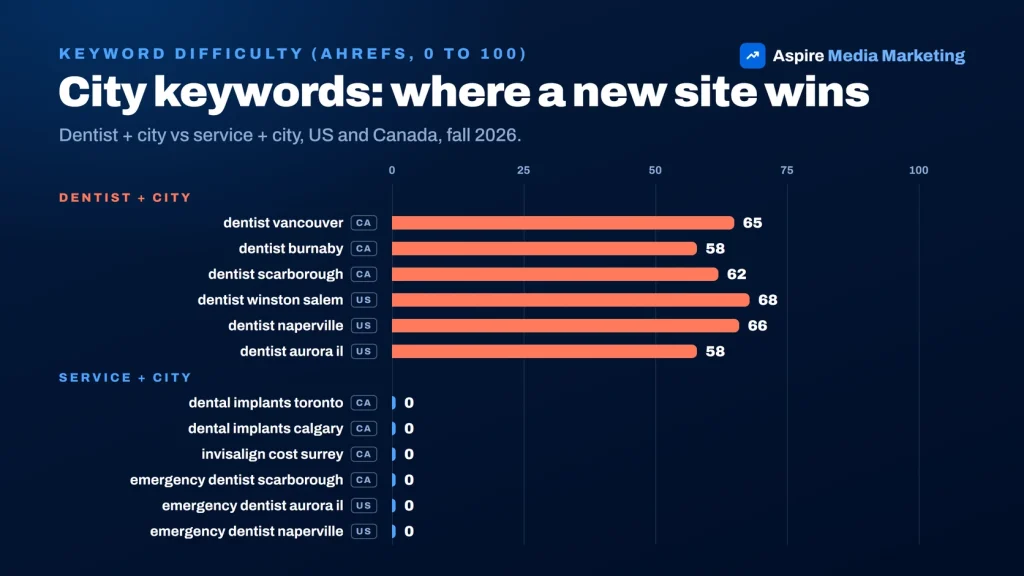
This is the pattern that matters most for a practice that is not ranking yet. Every “dentist + city” term in the table below scores 58 to 68 for difficulty. Every “service + city” term scores 0. The searches are smaller, but they are wide open, and the person searching them already knows what treatment they want.
| Keyword | Country | Searches/mo | Difficulty |
|---|---|---|---|
| dentist vancouver | Canada | 1,000 | 65 |
| dentist burnaby | Canada | 600 | 58 |
| dentist scarborough | Canada | 300 | 62 |
| dentist winston salem | US | 700 | 68 |
| dentist naperville | US | 300 | 66 |
| dentist aurora il | US | 300 | 58 |
| dental implants toronto | Canada | 1,100 | 0 |
| dental implants calgary | Canada | 1,100 | 0 |
| invisalign cost surrey | Canada | 200 | 0 |
| emergency dentist scarborough | Canada | 150 | 0 |
| emergency dentist aurora il | US | 150 | 0 |
| emergency dentist naperville | US | 150 | 0 |
So build out the service pages before you pour effort into the homepage term. A practice can rank for “dental implants [city]” or “emergency dentist [city]” months before it cracks “dentist [city]”, and each service page that ranks sends authority back to the homepage through your internal links. One warning from our own work: we have seen a “best dentists in [city]” list post on a practice’s own blog outrank that practice’s homepage for its main city search. Two pages on one keyword split the result, so give the city term to one page only.
How to map dental keywords to pages
A keyword list only helps once every keyword has a home. Use one primary keyword per page, let close variants share that page, and never give two pages the same primary keyword.
| Keyword kind | Example | Page that should target it |
|---|---|---|
| Dentist + city | dentist [city], dental clinic [city] | Homepage, or one location page per office |
| Service + city | dental implants [city], invisalign [city] | One service page per treatment |
| Cost and comparison | veneers cost, dental bridge vs implant | Blog post that links to the service page |
| Problem and symptom | chipped tooth, toothache | Emergency page plus short blog guides |
| Near me | dentist near me, kids dentist near me | Google Business Profile, backed by the site |
| Brand | your practice name | Homepage and Business Profile |
Link each blog post to its service page with words that describe the treatment, such as “dental implants in Calgary”, rather than “click here”. That tells Google which page should rank for the money keyword and keeps the blog post from competing with it.
Want a keyword map like this built for your practice?
How to choose which keywords to go after first
Sort your list in this order, and only use search volume to break a tie:
- Case value. One implant or Invisalign case can be worth more than a year of cleanings for one patient. Start with the treatments that move your revenue.
- Intent. A service + city search is closer to a booking than a definition search. “cost”, “near me”, and a city name are strong signals.
- Difficulty. Prefer terms where the difficulty is low enough for your site’s current link profile. A new site should start under 10.
- Volume. Among keywords that pass the first three tests, take the bigger one.
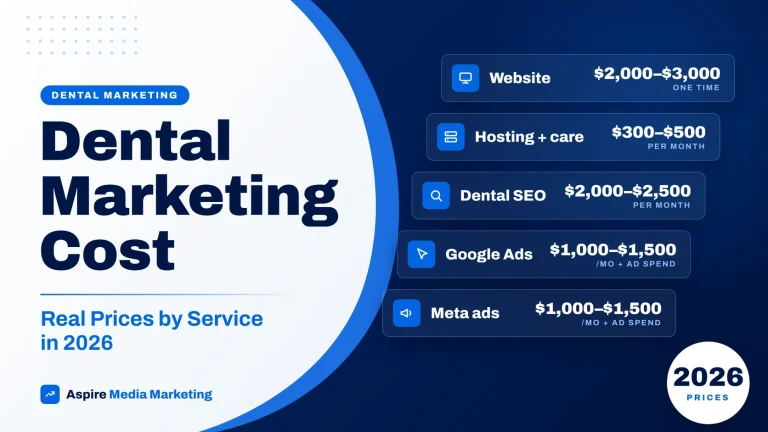
By that test, “dental implants toronto” at 1,100 searches and difficulty 0 beats “teeth whitening” at 222,000 searches and difficulty 68 for almost any practice. A practical first plan is three to five service + city keywords for your highest value treatments, then one cost guide for each of those treatments. If you want to know what that work usually costs, our dental marketing cost guide breaks it down by service.
Dental keyword mistakes we see most often
Most dental SEO tips stop at a keyword list. These are the mistakes that stop a good list from working:
- Chasing the biggest number. A keyword like “teeth whitening” has huge volume and a difficulty of 68. It will eat months of effort and may never send a patient.
- Two pages for one keyword. A blog post and a service page both aimed at “[service] [city]” split the result, and often neither ranks well.
- A city in every blog title. Cost and how to questions are mostly searched without a city. In Canada, “dental implant cost” gets 1,100 searches a month while “dental implant cost toronto” gets 200. Keep cities for service and location pages.
- Stuffing near me and suburb lists. Google treats it as spam, and patients find it hard to read.
- Targeting what you do not offer. A treatment, a sedation level, or a specialist title you cannot back up costs you trust with patients and can bring trouble with your regulator.
- Using the wrong country’s numbers. In the tables above, the US number is a median of about 15 times the Canadian one, and “veneers cost” gets 34,000 searches a month in the US against 1,100 in Canada. Plan with the numbers for the country your patients live in.
Free ways to find the keywords your patients already use
You do not need a paid tool to start. Your own accounts already hold the best keyword data you will find:
- Google Search Console. The Performance report lists the queries your site appeared for, with clicks, impressions, click rate, and average position. Queries with many impressions and few clicks are your quickest wins.
- Google Business Profile. The Performance view shows the search terms people used to find your profile. It updates at the start of each month.
- Google Keyword Planner. Keyword Planner gives monthly search estimates, but it lives inside Google Ads and asks for billing details before you can use it.
- Google itself. Type a treatment into the search box and read the suggestions and the People also ask questions. Those are the exact phrasings patients use.
- Your front desk. Write down how patients describe their problem on the phone for two weeks. It is often closer to what they type than any tool.
Want a second pair of eyes on what you find? Our dental SEO services start with exactly this research for your city and treatments, and our dental marketing ideas post covers what to do once the keywords are mapped.
Frequently asked questions
What are the best SEO keywords for dentists?
The best SEO keywords for dentists pair a high value treatment with your city, such as dental implants plus your city name, followed by cost and comparison questions for your blog. In our data, dental implants toronto gets about 1,100 searches a month in Canada with a keyword difficulty of 0.
How many keywords should a dental website page target?
Give each page one primary keyword and let close variants share it. A dental implant page can rank for dental implants, implant dentist, and tooth implant in your city at the same time. Two pages with the same primary keyword compete with each other.
Should I put near me in my website copy?
No. Google works out the searcher’s location on its own, and it says local results are mainly based on relevance, distance, and how well known a business is. Win near me searches through your Google Business Profile, reviews, and consistent contact details, and avoid lists of cities, which Google treats as keyword stuffing.
What is keyword difficulty?
Keyword difficulty is an Ahrefs score from 0 to 100 that estimates how hard it is to reach the first page of Google for a keyword, based on how many websites link to the pages ranking there now. It is a guide, not a promise, and it means little for near me searches, where location decides the results.
Are dental keywords different in Canada and the US?
Yes. In our data the US volume for the same keyword is a median of about 15 times the Canadian one, and the vocabulary differs. Canadians search for the Canadian Dental Care Plan and direct billing, with cdcp dentist near me at about 2,500 searches a month, while US patients search for payment plans and Medicaid. Always plan with the numbers for your own country.
Where can I find the keywords my patients already use?
Start with the Queries list in Google Search Console and the search terms in your Google Business Profile performance view, which updates at the start of each month. Google Keyword Planner adds monthly search estimates but needs a Google Ads account with billing details.
Where to start
Pick your three most valuable treatments. For each one, find the service + city keyword and the cost question in the tables above, check that you have one page for each, and link the cost post to the service page. That small map will do more for your bookings than a list of a hundred keywords that never gets a home.
Ready to grow your dental practice?
Get a free, no-obligation strategy session and a custom growth plan for your practice.
Book Your Free Call →Keep Reading