Most dental social media advice stops at the idea. “Post a team spotlight.” “Share a before-and-after.” Great — now it is 8:40 on a Tuesday, the schedule has a gap, and someone still has to write the actual caption.
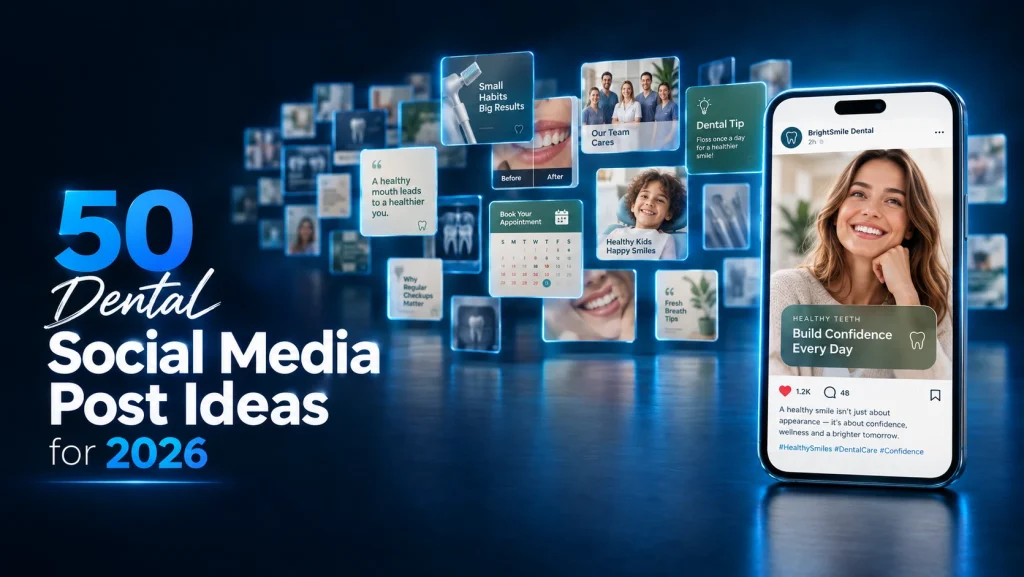
So this list does both. Below are 50 dental social media post ideas organized into the five buckets a practice account actually needs, and every single one comes with a caption you can copy, paste and post. There is also a section most idea lists skip entirely: what a dental practice is and is not allowed to publish, which differs sharply between Ontario and the United States.
In this guide: How to use this list · The compliance rules · The 50 ideas · Instagram vs Facebook · 30-day calendar · Campaign ideas · FAQ
Quick answer: The most effective dental social media posts fall into five buckets — educational posts that answer real patient questions, team and behind-the-scenes content that builds familiarity, treatment results shared with documented consent, interactive posts that invite a reply, and booking posts that name a specific next step. A practical mix is roughly 40% educational, 20% team, 15% results, 15% engagement and 10% booking, published three to five times a week.
Key takeaways
- Patients now check several places before booking. BrightLocal’s 2026 Local Consumer Review Survey found 97% of consumers read reviews for local businesses, and that the average consumer consults about six different platforms — your social profiles are part of that check whether you post or not.
- Recency is now judged, not just quality. 74% of consumers look for reviews written in the last three months, and a dormant social feed reads the same way: as a signal that nobody is home.
- Ontario practices operate under materially different rules. The RCDSO’s advertising advisory restricts testimonials, superlative claims, and contests or giveaways — all of which US-written idea lists recommend freely.
- Every caption in this article is deliberately written without superlatives, guarantees or comparative claims, so it can be used as-is in either country.
- Judge the account on booked patients and direct messages, not on likes. A post with 40 likes that produced two appointment requests beat the one with 400 that produced none.
How to Use This List of Dental Social Media Ideas
Do not work through 50 posts in order. Pick from the buckets instead, because a feed that mixes categories holds attention far better than ten education posts in a row.
The five buckets, and roughly how much of your feed each should occupy:

| Bucket | Share of feed | What it does |
|---|---|---|
| Educational (ideas 1–10) | ~40% | Answers the questions patients are already typing into Google. Builds authority and gets saved and shared. |
| Team and behind-the-scenes (11–18) | ~20% | Reduces the anxiety that keeps nervous patients from booking. Consistently the highest-engagement content for dental accounts. |
| Results and proof (19–26) | ~15% | Shows capability. Carries the heaviest consent and compliance requirements — see the next section before posting any of these. |
| Engagement (27–34) | ~15% | Invites replies, which is what tells the platform to keep showing your posts to local people. |
| Seasonal and booking (35–50) | ~10% | Converts the audience the other four buckets built. Always names one specific next step. |
Two rules make the difference between a feed that works and one that just exists. First, every post needs one job — teach something, show someone, or ask for something. Posts that try to do all three do none. Second, put the point in the first line. On both Instagram and Facebook the caption truncates, and the sentence before “more” decides whether anyone reads the rest.
If you would rather hand the whole cycle to someone else, that is what our dental social media marketing service exists for. If you are building the wider picture around it, start with our guide to digital marketing for dentists.
Before You Post: The Compliance Rules Most Dental Social Media Ideas Ignore
This is the section that gets left out of almost every “dental social media ideas” article, and it is the one that can cost you. Dental advertising is regulated, social posts generally count as advertising, and the rules are not the same on both sides of the border.
In Ontario, the Royal College of Dental Surgeons of Ontario treats a post from an account identifying its holder as a dentist as advertising. Its practice advisory on professional advertising prohibits testimonials and statements that can only be verified by a person’s personal feelings, superlative or comparative terms such as “state of the art” and “cutting edge”, statements that create an expectation of favourable results, and incentive programs including giveaways, contests and draws.
Read that last one again, because roughly every American dental marketing listicle opens with “run a giveaway”. In Ontario, that is a compliance problem, not a growth tactic.
In the United States, the binding constraint is patient privacy. Identifiable patient images — and under HIPAA, full-face photographs count as protected health information — require written patient authorization before they are used in marketing. A usable authorization names who may use the image, where it may appear, when it expires, and how the patient revokes it. Several states layer additional requirements on top, particularly around before-and-after photography.
| Post type | Ontario (RCDSO) | United States |
|---|---|---|
| Patient testimonial or review screenshot | Restricted — testimonials are prohibited in advertising | Generally permitted with written authorization |
| Before-and-after photo | Consent required; must not imply guaranteed results | Written HIPAA authorization required; some states require result disclaimers |
| Contest, giveaway or prize draw | Prohibited as an incentive program | Generally permitted; check state board rules |
| “Best dentist in town” / “state of the art” | Prohibited as superlative or comparative language | Risky — must be substantiated, and boards vary |
| Educational and team content | Permitted — must be factual and verifiable | Permitted — no patient PHI without authorization |
This is general information for marketing planning, not legal advice. Rules change and vary by province and state — confirm current requirements with your own regulatory college or state board before publishing patient content.
Three habits keep a practice out of trouble: get written consent before the photo is taken rather than after, keep a signed consent on file for every image you publish, and route every post through one named approver. That is it. None of it is hard, and all of it is easier than the alternative.
50 Dental Social Media Post Ideas (With Captions You Can Copy)
Each idea below includes the caption. Swap in your practice name, city and booking link, and it is ready to schedule. Nothing here uses superlatives or promises a result, so the wording is safe to publish in Ontario as well as the US.
Educational dental social media posts (1–10)
1. The “is this normal?” post. Take the single most common worry patients raise at the chair and answer it plainly. Bleeding gums when flossing is the highest-volume version and almost always gets saved.
Caption: Gums bleed when you floss? That is not something to push through quietly. Bleeding is usually inflammation, which means the gum is reacting to plaque sitting along the gumline. It often settles within a week or two of daily flossing. If it does not, book a check — we would rather look early. Questions? Send us a message.
2. Myth versus fact. A two-panel graphic with the myth on one side and the correction on the other. Simple to produce, endlessly repeatable, and it quietly positions you as the person who knows.
Caption: Myth: if nothing hurts, nothing is wrong. Fact: cavities and gum disease are usually painless in their early stages — which is exactly when they are simplest to treat. Pain tends to arrive late. That is the whole reason checkups exist. What dental myth have you heard that you would like us to settle?
3. The 60-second procedure explainer. Film yourself explaining one treatment in plain language, no jargon. Root canals are the highest-anxiety topic and therefore the highest-value explainer you can post.
Caption: What actually happens during a root canal, in 60 seconds. We numb the tooth, remove the infected tissue inside it, clean and seal the space, then restore the tooth so you can chew on it normally again. Most people describe it as similar to having a filling done. Have a question you have been too polite to ask? Ask it below.
4. What that dental term actually means. Patients nod along to words they do not know. Decode one per week — occlusion, abutment, scaling, root planing, crown lengthening.
Caption: Dental translation, part four: “scaling and root planing”. Scaling is removing hardened plaque from the tooth surface, including below the gumline. Root planing smooths the root so the gum can reattach cleanly. Together they are the standard treatment for gum disease that has moved past the early stage. Which term should we translate next?
5. The cost of waiting. Show the treatment ladder for one problem — small filling, large filling, root canal and crown, extraction and implant — and let the progression speak. Do not name prices unless you are prepared to honour them.
Caption: One small cavity has four possible futures. Caught early it is a filling. Left alone it can become a larger filling, then a root canal and crown, and eventually an extraction. Same tooth, four very different appointments. This is the entire argument for regular checkups, and it is why we call when you are due.
6. The two-minute technique demo. Film hands and a model, not a face. Angle the brush at 45 degrees, small circles, tongue included. It is the most-saved format in dental social media.
Caption: Most people brush for about 45 seconds and think it has been two minutes. Here is the two-minute version: 30 seconds per quarter of the mouth, brush angled toward the gumline, small circles rather than scrubbing side to side, and finish with the tongue. Save this and try it tonight.
7. What we are actually looking for on an X-ray. Use your own anonymised radiograph and annotate it. This one performs unusually well because almost nobody has had it explained to them.
Caption: When we look at your X-ray, we are checking four things: decay between teeth where a mirror cannot reach, the bone level supporting each tooth, anything happening at the root tips, and how the teeth that have not come through yet are positioned. That is why we take them, and why we space them out rather than taking them every visit.
8. Food and drink, ranked by what it does to enamel. Practical, shareable, and it lands without lecturing if you include the “how to reduce the damage” line.
Caption: We are not going to tell you to give up coffee. But here is what helps: drink it within a set window rather than sipping across three hours, rinse with water afterwards, and wait about 30 minutes before brushing so you are not brushing softened enamel. Frequency does more damage than quantity.
9. The kids’ dental timeline. Parents search this constantly — first tooth, first visit, first loose tooth, sealants, orthodontic assessment. One graphic answers a year of questions.
Caption: A parent’s timeline for children’s teeth. First tooth usually appears around six months. First dental visit is recommended by the first birthday or within six months of that first tooth. Brushing starts as soon as a tooth appears. An orthodontic assessment is commonly suggested around age seven, while the jaw is still growing. Save this one for later.
10. When to call us and when it can wait. A triage post. Genuinely useful, and it reduces both unnecessary panic and dangerous delay.
Caption: Call us the same day for: a knocked-out adult tooth, swelling in the face or jaw, or pain that is keeping you awake. Call within the week for: a chipped tooth with no pain, a lost filling, or sensitivity that has lasted more than a few days. Not sure which one you are? Call anyway — sorting that out is part of our job.
Team and behind-the-scenes posts (11–18)
11. Meet the team, properly. Not a headshot and a job title. Ask three fixed questions of every team member so the series has a recognisable shape.
Caption: Meet Sarah, one of our hygienists. Years in dentistry: nine. The part of the job she likes most: working with people who used to dread appointments and now do not. What she wishes everyone knew: flossing is not about food, it is about what builds up between the teeth over the day. Say hello in the comments — she reads them.
12. A day in the life. Short clips from open to close, stitched together. It answers the unspoken question of what happens in a place most people only see from a chair.
Caption: A Tuesday, from 7:40am. Morning huddle to go through the day’s schedule, instruments checked and set, first patient at 8. Somewhere in there, coffee. We finish by going through tomorrow so nobody starts the day cold. This is the part you do not see from the chair.
13. The sterilization tour. Show your instrument reprocessing area and explain the cycle. Post-pandemic this remains one of the highest-trust pieces of content a practice can publish.
Caption: Where your instruments actually go between patients. Everything is cleaned, bagged, and run through the autoclave under pressurised steam. Each load is logged, and we run test cycles to confirm the machine is doing what it should. The pouch only gets opened in front of you. You are welcome to ask to see any of this.
14. New equipment, explained by what it changes for the patient. Skip the model number. Say what is different from the chair. Note that Ontario practices cannot describe it as “state of the art”.
Caption: There is a new scanner in the practice, and here is what it changes for you: no impression tray, no putty, no gagging. We move a small wand around your teeth and a 3D model builds on screen while you watch. It takes a few minutes and you can see the result immediately. That is the whole upgrade.
15. Team milestones. Work anniversaries, new certifications, a new team member starting. Low effort, high warmth, and it signals stability — which patients read as safety.
Caption: Ten years ago this week, Maria joined us at the front desk. If you have called this practice at any point since, you have spoken to her. She knows which of you need the first appointment of the day and which of you need reminding twice. Thank you, Maria. Leave her a note below.
16. What we are learning. Post from a course or conference. It shows the practice is still developing without making a single comparative claim.
Caption: Two of us spent the weekend in a course on managing dental anxiety — specifically how to structure a first appointment for someone who has avoided dentistry for years. We came back with changes we are already making to how we run those visits. Continuing education is a requirement in this profession. We treat it as more than that.
17. Why I became a dentist. The founder story. Post it once a year and pin it. It is the single strongest trust asset most practices already have and never use.
Caption: I did not grow up wanting to be a dentist. I grew up terrified of them. A dentist in my teens took the time to explain what she was doing before she did it, and the fear simply went. That is the entire reason this practice runs the way it does. If you have been putting off a visit, we have heard your version of it before.
18. The people who answer the phone. Front desk staff are the first human contact and almost never appear on the feed. Fixing that measurably reduces call reluctance.
Caption: When you call us, this is who picks up. Priya and James handle appointments, insurance questions and the “I am not sure if this counts as an emergency” calls — which they would genuinely rather you make than not. No question is too small for that phone line.
Results and social proof posts (19–26)
Every idea in this bucket carries consent obligations. Read the compliance section before you publish any of them, and remember that Ontario practices cannot post testimonials at all.
19. The before-and-after, done properly. Same angle, same lighting, same lip retraction. Inconsistent framing reads as exaggeration even when it is not. Written consent on file before the first photo, always.
Caption: Eleven months of orthodontic treatment, shared with this patient’s written permission. Same camera position in both photos so you are seeing the actual change and nothing else. Every case is different and results vary with the starting position, age and how consistently aligners or appliances are worn. If you are wondering what your own starting point looks like, an assessment is the way to find out.
20. The reveal video. Film the moment a patient sees the result. It outperforms the static photo because the reaction is the proof, not the teeth. Clear consent to film and to publish, separately.
Caption: The mirror moment, shared with permission. This is the part of the job that does not show up on a treatment plan. Every case takes its own path and its own timeline — but the appointment where someone stops covering their mouth when they laugh is consistently the good one.
21. Walk through a case without showing the patient. The compliance-free version of a results post: photograph the model, the scan, the appliance or the radiograph, and narrate the reasoning. Practices marketing higher-value treatment lean on this format heavily — it is the backbone of most dental implant marketing content.
Caption: How we plan an implant before anything happens in the mouth. We scan, then build the position digitally against the bone available and the bite as it actually closes. The guide you are looking at is printed from that plan. By the time we place the implant, the position has already been decided. Planning is most of the work.
22. The review post — and the Ontario exception. In the US, sharing a Google review as a graphic is standard practice with authorization. In Ontario it is not available to you: the RCDSO advisory prohibits testimonials in advertising. Ontario practices should post the takeaway instead of the quote.
Caption (Ontario-safe version): The thing we hear most often from people who had not seen a dentist in years is that they expected to be lectured. We do not do that. We work out where you are, what is urgent, what can wait, and what it will take. No commentary on how long it has been.
23. The milestone. Years open, families seen, a hygienist’s thousandth cleaning. Factual, verifiable numbers only — which is exactly what the regulations require anyway.
Caption: Fifteen years on this street this month. In that time we have watched patients arrive as children and come back with children of their own, which is a strange and quite good feeling. Thank you to everyone who has trusted us with that. We are still taking new patients, and still answering the phone ourselves.
24. Community involvement. The minor hockey team you sponsor, the school you visit, the food drive in the waiting room. This is local relevance that no competitor can copy.
Caption: Third season sponsoring the U11 team, and this year they have matching jerseys that do not fit anyone properly. We were there Saturday. If your club or school needs mouthguards or someone to come and talk to a class about teeth, send us a message — we do both, and we do not charge for it.
25. The day you give something back. A free care day, a veterans’ clinic, a children’s screening morning. Document it as reporting, not promotion.
Caption: We closed the schedule on Friday and opened the doors instead. Twenty-two people came through for cleanings, exams and a few urgent extractions, at no cost. Thank you to the team who gave up a day off to be here, and to the local pharmacy who sent supplies. We will do it again in the spring.
26. Credentials, stated factually. Provider status, accreditation, a specific training certification. State what it is and what it required — never that it makes you better than anyone else.
Caption: Our provider status was renewed for 2026. It is based on the number of cases completed each year, so it reflects volume and ongoing experience with the system rather than any judgement about outcomes. What it means practically: this is a treatment we work with often. Happy to explain what that involves if you are considering it.
Fun and interactive dental social media posts (27–34)
These exist to generate replies. A comment or a poll tap tells the platform your content is worth showing to more local people, which is what makes the other four buckets work.
27. This or that. Electric or manual. Mint or cinnamon. Morning or night flosser. Two seconds to answer, which is why the response rate is so high.
Caption: Settle something for us. Electric or manual toothbrush? Both work if the technique is right — electric just makes the right technique easier to achieve, particularly if you brush quickly. Vote below, and tell us if you switched and regretted it.
28. Dental trivia. One question, answer revealed the next day. It builds a small habit of coming back.
Caption: Question: which is the hardest substance in the human body? Guess before you scroll. Answer tomorrow. Hint — you are using it right now, and it does not grow back once it is gone.
29. Ask us anything. Open the question sticker for 24 hours, then answer the best ones as individual posts. One session can produce a fortnight of content.
Caption: Ask a dentist anything, open until tomorrow. Anonymous, no judgement, nothing too basic. Past favourites include “does whitening damage teeth”, “why does the drill sound like that”, and “how bad is it really that I do not floss”. Send yours.
30. Caption this. An odd photo from the practice with the caption left to the audience. Pure engagement bait, and it works.
Caption: Caption this. Dr. Chen has been holding this pose for reasons nobody in the practice can now explain. Best one goes on the staff room wall, where it will be seen by six people and never mentioned again.
31. The team takeover. Hand the account to a different team member for a day. The change in voice is the point — it makes the practice feel like people rather than a logo.
Caption: Hi, it is Dan, dental assistant, and I have the phone today. I am going to show you what I set up before each appointment, which trays cause arguments, and what happens in the ten minutes between patients. Send me questions and I will answer them as I go.
32. The honest checklist. “Rate your oral health routine” — five items, count how many you do. Self-scoring posts get saved and sent to a partner, which doubles reach.
Caption: Score yourself out of five, honestly. Brush twice a day. Two full minutes each time. Clean between the teeth daily. Replace the brush every three months. Been seen in the last year. Three or more is a decent place to be. Fewer than three and you are in the majority — and it is fixable. Send this to whoever needs to see it.
33. Two truths and a lie. Three dental claims, one false, answer in the comments. It teaches while it entertains.
Caption: Two truths and a lie. One: you can rebuild enamel that has already worn away. Two: grinding your teeth at night can crack a molar. Three: gum disease has been linked with other health conditions in the research. Which one is the lie? Answer in the comments this afternoon.
34. The trend, adapted. Use a current audio or format, but attach it to something true about your practice. Trends without substance age badly and convert nobody.
Caption: Things patients say in the chair that we hear every single day, ranked by how often. Number one, unchallenged for years: “I know, I should floss more.” You are allowed to just come in. Nobody here is keeping score.
Seasonal and awareness-day dental posts (35–42)
35. Back-to-school checkups. Post it in the second week of August, before the calendar fills. Parents book on urgency, and the urgency is real.
Caption: September fills up faster than any month we have. If your kids are due for a checkup, booking it now means you get an after-school slot rather than pulling them out of class in October. We keep the last appointments of the day for school-age patients through the autumn. Link in bio, or call us.
36. The Halloween post. Do not tell people not to eat candy. Tell them which types clear the mouth fastest and when to eat them.
Caption: Halloween, from a dentist who is not going to tell you to skip it. Chocolate clears the mouth quickly. Sticky and sour sweets sit on the teeth far longer and the sour ones are acidic on top of that. Eat sweets with a meal rather than grazing across the evening, and rinse with water after. That is the whole strategy.
37. The travel kit. A holiday-season post about keeping a routine on the road. Light, practical, and it lands in a week when nobody else is posting anything useful.
Caption: Travelling this month? Pack a spare brush head, floss picks because you will not use string floss in a hotel bathroom, and your night guard if you wear one. If something goes wrong while you are away, call us anyway — we can usually tell you whether it needs attention now or can wait until you are home.
38. New year, one specific goal. Vague resolutions fail. Ask for one measurable change instead, which also makes for a better comment thread.
Caption: Skip “take better care of my teeth” this year. Pick one thing you can actually check: floss before bed, replace the brush head this week, or book the appointment you have been putting off since spring. One is enough. Tell us which one and we will check in with you in February.
39. Benefits before they reset. Post it in early November. This is consistently one of the highest-converting posts of the year in both countries.
Caption: If your dental plan runs on a calendar year, anything unused on December 31 does not carry over. Most plans reset then, and December is the month everyone remembers at once. If you have treatment outstanding or a cleaning you have not used, this is the point to book it. Not sure what you have left? Call and we will check with you.
40. Wedding and event season. February through May, aimed at people with a date in the calendar. This is where Invisalign marketing and whitening content earn their keep — the deadline does the persuading.
Caption: Getting married this year, or standing up at someone else’s? Work backwards from the date. Whitening needs a couple of weeks. Straightening with aligners is usually measured in months, and bonding or veneers need planning time on top. If your date is inside twelve months, now is when to have the conversation, not in the spring.
41. Mouthguards, before the season starts. Post it in the fortnight before local sport resumes, not after the first injury.
Caption: Season starts in two weeks. A custom mouthguard is moulded to the teeth, so it stays put and players actually keep it in — which is the entire difference between a mouthguard and a mouthguard in a kit bag. One appointment, ready before the first game. We do team bookings.
42. Awareness month, made local. April is Oral Health Month in Canada; October is National Dental Hygiene Month in the US. Attach a local action rather than a hashtag.
Caption: It is Oral Health Month, which usually means a lot of posts and very little happening. So here is something concrete: for the rest of the month we are holding two appointments a week for people who have not seen a dentist in over five years. No lecture, no judgement, just a look and a plan. Message us and we will book you into one.
Booking and conversion posts (43–50)
Every post in this bucket names one specific next step. That is the only thing separating a booking post from a brand post.
43. The open appointment. A cancellation this week, posted the morning it happens. It is the fastest-converting post format a dental practice has.
Caption: We have had a cancellation: Thursday at 2:20pm, cleaning and exam. If you have been meaning to book and could not find a time that worked, this is one. First message gets it.
44. What actually happens at a first visit. Anxiety about the unknown stops more bookings than cost does. Remove the unknown, minute by minute.
Caption: Your first appointment here, start to finish. Ten minutes of paperwork and history. A conversation about what you want and what worries you, before anyone picks anything up. An examination and, if needed, X-rays. Then we talk through what we found and what it would take, in order of priority. You leave with a plan, not a bill you were not expecting.
45. Insurance in plain English. Coverage confusion delays treatment constantly. Explaining one term per post is a genuine service.
Caption: “Annual maximum” is the most misread line on a dental plan. It is the most your plan will pay in a year — not the most you are allowed to spend, and not a budget you have to use up. Once you hit it, further treatment is yours to cover. Knowing your number changes how you sequence treatment. Bring your plan details and we will read it with you.
46. We are accepting new patients. Obvious, and almost nobody posts it. People genuinely do not know whether a practice has capacity.
Caption: We are taking new patients, including families. If you have moved to the area, changed plans, or simply not had a dentist for a while, you can book directly — no referral needed. Evening appointments available on Tuesdays and Thursdays. Link in bio.
47. Emergency availability. Post it quarterly. When someone needs it, they need it that hour, and they will search whoever they last saw say it.
Caption: We hold time every weekday for dental emergencies. Knocked-out tooth, swelling, a broken tooth, pain that is stopping you sleeping — call first thing and we will find you a slot that day. Save this number now rather than searching for it at 7am on a Monday.
48. Thank you for the referrals. Acknowledge the behaviour without rewarding it — incentives for referrals or reviews are restricted in Ontario and against Google’s policies everywhere.
Caption: Most of the people who walked in here for the first time last month came because someone they know told them to. We do not run a rewards scheme for that and we are not going to — but we do notice it, and it is the reason this practice is still here after fifteen years. Thank you.
49. How to book, shown on screen. Record the actual booking flow. Every extra step you remove converts someone who would otherwise have closed the tab.
Caption: Booking online, in real time, no edit. Pick appointment type, pick a day, pick a time, enter your details. Twenty-two seconds. If you would rather speak to a person, the number is in the bio and Priya will pick up.
50. Here when you are ready. The post for people who have avoided dentistry for years. It converts slowly and it converts the patients who need you most.
Caption: If it has been five years, or ten, or you genuinely cannot remember — you are not the first person to walk in here saying that, and you will not be this week either. We will look, tell you what we find in plain language, and work out an order to do things in. You can stop at any point. Whenever you are ready.
Dental Instagram Post Ideas vs Facebook: What Works Where
The same idea does not perform the same on both platforms, and for most dental practices the two audiences are genuinely different people. Facebook skews older and more local-community driven. Instagram skews younger and more visual. Posting identical content to both is the most common avoidable mistake in dental social media.
| Best-performing ideas | 6, 12, 19, 20, 29, 31, 34 — anything with movement or a face | 9, 15, 24, 25, 39, 46, 47 — community, practical detail, longer text |
| Format that wins | Reels and carousels; Stories for the interactive posts | Single image with a substantial caption; native video |
| Caption length | Short. The hook is the first line and often the only line read | Longer is fine — Facebook audiences read the whole post |
| Where booking happens | Link in bio and direct messages | In-post links and Messenger — links do not suppress reach the way they do on Instagram |
| Typical patient | Cosmetic, orthodontic and whitening enquiries; adults under 40 | Family bookings, restorative treatment, new residents in the area |
Practical rule: produce for Instagram first, because video and vertical formats travel down to Facebook easily while the reverse rarely works. Then rewrite the caption for Facebook rather than copying it — usually that means adding the practical detail you cut for brevity, and putting the booking link directly in the post.
Organic posting builds the audience that already knows you. When you need to reach people who do not, that is a different job — see Facebook and Instagram ads for dentists, which works best layered on top of a feed that already looks alive.
A 30-Day Dental Social Media Content Calendar
Four posts a week, mapped to the numbered ideas above. Copy this into your scheduler and you have a month of dental social media content without another planning meeting.

| Week | Monday | Wednesday | Friday | Saturday |
|---|---|---|---|---|
| 1 | Educational — idea 1 | Team — idea 11 | Engagement — idea 27 | Booking — idea 46 |
| 2 | Educational — idea 6 | Behind the scenes — idea 13 | Results — idea 21 | Engagement — idea 29 |
| 3 | Educational — idea 3 | Team — idea 18 | Seasonal — pick from 35–42 | Booking — idea 44 |
| 4 | Educational — idea 10 | Community — idea 24 | Engagement — idea 32 | Booking — idea 43 or 47 |
Batch the production. One afternoon a month, film six short videos and photograph four graphics, then schedule the lot. Practices that batch stay consistent; practices that post when inspiration strikes go quiet by week three, and a quiet feed does real damage — it is the same signal a stale review profile sends.
6 Dental Social Media Campaign Ideas That Go Beyond Single Posts
A campaign is several connected posts pointed at one outcome. Campaigns outperform standalone posts because repetition is what makes a message stick, and because each post reaches a slightly different slice of your audience.
1. The five-day team series. One team member a day for a week, same three questions each time (idea 11). By Friday the audience recognises names, and the practice stops being an anonymous building.
2. The consent-first results series. Six weeks, one case per week, every image consented in writing before treatment starts (ideas 19–21). Build the consent step into your treatment-planning appointment and the content produces itself.
3. The question-led education run. Collect questions with an ask-me-anything (idea 29), then answer the best six as individual posts over the following fortnight. Audience-generated, so it is guaranteed to be relevant.
4. The benefits countdown. Four posts across November and December (idea 39), each naming how many weeks remain before plans reset. It converts because the deadline is real and not manufactured.
5. The new-patient welcome sequence. Three posts that run permanently as pinned or highlighted content: what a first visit involves (44), how to book (49), and the here-when-you-are-ready post (50). This is the sequence that turns a follower into an appointment.
6. The local collaboration. Partner with a nearby business — a gym, a coffee shop, a bridal boutique — and post to each other’s audiences. It is the only tactic here that reaches people who have never heard of you without paying for it.
A note on contests. “Dental contest ideas” is a popular search, and in much of the US a giveaway is a legitimate tactic. In Ontario it is not: the RCDSO advisory lists incentive programs including giveaways, contests and draws among prohibited advertising. If you practise in Ontario, use campaign 3 or 6 instead — they generate comparable engagement without the risk. If you practise elsewhere, check your own state board before running one.
How Often Should a Dental Practice Post on Social Media?
Three to five times a week is the range where most dental practices see steady growth without burning out the person doing the work. Four is a sensible target: it fills the calendar above, leaves room to react to something local, and is sustainable with one batching session a month.
What matters far more than frequency is consistency. An account that posts four times a week for two months and then stops for six weeks performs worse than one that posts twice a week indefinitely. The gap is the problem, not the volume — a prospective patient who finds a feed whose last post is four months old draws exactly the conclusion you would expect.
If four a week is not realistic, drop to two and protect them. Two posts a week, every week, beats an ambitious schedule you abandon in March.
How to Tell If Your Dental Social Media Is Actually Working
Likes are the least useful number on the screen. Judge the account on whether it produces patients, using four measures in order of importance:
- Appointment requests from social. Direct messages asking to book, and bookings from the link in your bio. This is the number that matters. If your booking system cannot tell you where a booking came from, ask the patient at check-in and write it down.
- Saves and shares. A save means someone intends to act later; a share means they vouched for you to somebody else. Both predict bookings far better than likes do.
- Profile visits and website clicks. The intermediate step between seeing a post and becoming a patient. Rising profile visits with flat bookings usually means the booking path is the problem, not the content.
- Branded search volume. If people start searching your practice name directly, your social presence is doing its job. You can see this in Google Search Console.
Review the numbers monthly, not daily, and look at which of the five buckets produced the results. Most practices discover their best dental social media posts are not the polished ones — they are the team posts and the plain-language explainers.
Social is one channel among several, and it works best when the rest of the picture is in place: a site that ranks for local searches (SEO for dentists), paid campaigns for immediate volume (Google Ads for dentists), and a review profile that stands up to scrutiny. Our dental marketing services cover the whole set, and if you are weighing up who to work with, we wrote an honest comparison of the top dental marketing agencies — including ourselves.
If posting consistently is the part that keeps slipping, that is the specific problem our dental social media marketing service was built to solve: we plan, produce and schedule the whole calendar so the feed stays alive without it landing on your front desk.
Frequently Asked Questions About Dental Social Media Posts
What should a dental practice post on social media?
Split content across five buckets: educational posts answering common patient questions, team and behind-the-scenes content, treatment results shared with documented consent, interactive posts that invite replies, and booking posts naming a specific next step. Roughly 40% educational, 20% team, 15% results, 15% engagement and 10% booking works for most practices.
How often should a dentist post on social media?
Three to five times a week, with four as a practical target. Consistency matters more than volume — posting twice a week every week outperforms posting daily for a month and then going quiet. Batch a month of content in a single session to make the schedule sustainable.
What are the best dental social media post ideas for Instagram?
Video-led ideas perform best on Instagram: two-minute brushing technique demos, 60-second procedure explainers, day-in-the-life clips, treatment reveal videos with consent, ask-me-anything sessions and team takeovers. Reels and carousels reach further than static images, and the first line of the caption does most of the work.
Can dentists post patient before-and-after photos on social media?
Yes, with written consent obtained before the images are used. In the US, identifiable patient images are protected health information under HIPAA and require a written authorization naming who may use the image, where it will appear, when it expires and how the patient revokes it. In Ontario, consent is likewise required and the post must not create an expectation of guaranteed results. Some US states add further requirements such as disclaimers on atypical results.
Can Ontario dentists run social media contests or giveaways?
No. The RCDSO’s practice advisory on professional advertising lists incentive programs — including giveaways, contests and draws — among the things prohibited in dental advertising, and a post from an account identifying its holder as a dentist is generally treated as advertising. Ontario practices should use question-led campaigns or local business collaborations instead, which generate comparable engagement without the compliance risk.
How do you measure whether dental social media is working?
Measure appointment requests from social first — direct messages asking to book, and bookings through the link in your profile. Then saves and shares, which predict future bookings better than likes; then profile visits and website clicks; then branded search volume in Google Search Console. Review monthly rather than daily, and track which content bucket produced the results.
Ready to grow your dental practice?
Get a free, no-obligation strategy session and a custom growth plan for your practice.
Book Your Free Call →Keep Reading